Artificial intelligence has never been more capable. Generative AI can write, analyze, code, design, search, summarize and increasingly reason. Agentic AI is now taking the next step, enabling systems to plan and execute actions on a user’s behalf. Yet organizations continue to struggle to convert AI experimentation into sustained business value [1].
This creates an intriguing paradox: the problem increasingly isn’t that the AI doesn’t work. The problem is that firms cannot make the AI work in their businesses.
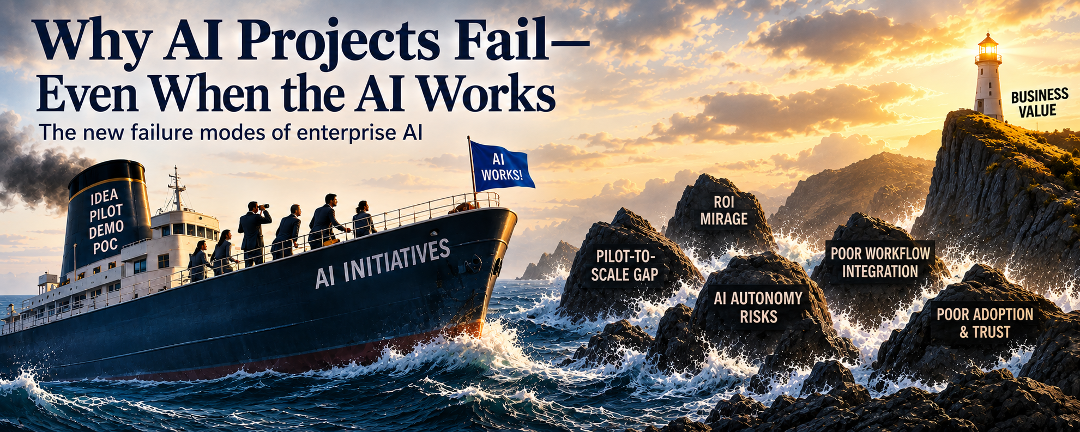
Artwork by author, with help from AI.
Two years ago, we investigated why AI projects fail, identifying seven major failure factors, and suggesting possible mitigation strategies [2]. Much has changed since then. AI capabilities have advanced dramatically, and failure modes have shifted and new ones have emerged.
The central message of this update is simple: AI failure is moving from a technology problem to an organizational, economic, and managerial problem.
How Many AI Projects Actually Fail?
Recent claims that 80% or even 95% of AI projects fail have received enormous publicity [3]. But these figures should not be treated as universal failure rates. Different studies use different definitions of an AI project and different definitions of failure. Some include small departmental experiments or employee-developed “DIY” applications alongside formal enterprise initiatives. Others count abandonment, failure to reach production, failure to achieve ROI, and outright technical failure as if they were the same thing.
The much-publicized 95% failure figure from the MIT NANDA study, in particular, has been criticized for extrapolating beyond what its underlying research could reliably establish [4, 5]. The study examined both company-official AI projects and informal ones, such as employee-driven experimentation. The facts: 95% of the informal projects failed compared to 60% failure for official projects—60% is still high, but not as extreme as 95%.
 The fact remains, however, that organizations are having considerable difficulty successfully deploying AI—moving it from experimentation into production and measurable business impact. For example, S&P Global’s 2025 survey found that organizations were abandoning an average of 46% of their generative AI proof-of-concepts before production. The proportion of companies abandoning most of their AI initiatives rose from 17% to 42% [6].
McKinsey’s 2025 global survey tells a similar story from a different perspective: 88% of respondents reported regular AI use in at least one business function, yet nearly two-thirds said their organizations had not begun scaling AI across the enterprise [7].
Five AI Deployment Failure Modes
The current study investigates why AI projects fail so often, especially in deployment (see “How the Study Was Done”). AI itself is rarely the point of failure. It is a magnifier—it exposes weaknesses that were already there in how an AI project is scoped, tested, and governed. Five modes of failure were identified, are outlined below, and are summarized in Table 1:
1. The Pilot-to-Scale Gap
The first major failure mode is deceptively simple: the AI works in the pilot, but it doesn’t work so well when applied in the business. A typical AI journey looks like this:
The demo and pilot operate in a controlled and ideal environment: they use clean data, a limited number of users, and a narrowly defined problem. Deployment, however, introduces the real world: legacy systems, poor or scattered data, cybersecurity, regulatory requirements, workflow disruption, and many different users with differing needs. The result: the project stalls—pilot paralysis [8].
Table 1: AI Deployment Failure Modes, Their Frequency of Occurring, Impact, and Mitigating Strategies
Failure Mode |
Freq.
|
Impact
|
Key Mitigation Strategies
|
|
Pilot-to-Scale Gap
|
Very
High
|
Very
High
|
- Design the pilot for scale from the start—not simply to demonstrate that the technology works. Test data availability, system integration, cybersecurity, user adoption, operating costs, & performance under real-world conditions.
- Use a gated process, such as RAPID, with an explicit gate for the “Go-to-Scale/No-Scale” decision with predefined technical & economic criteria [12].
- Before scaling, confirm that the business has the people, processes, infrastructure, & budget required for full deployment.
|
|
The ROI Mirage
|
Very
High
|
Very
High
|
- Start with a clearly defined business problem & quantify the expected value before investing heavily in AI.
- Establish a baseline & specify measurable targets for revenue, cost reduction, productivity, quality, speed, or customer value.
- Calculate the full cost of ownership, including data preparation, integration, licenses, infrastructure, training, governance, human oversight, & ongoing model costs [12].
- Make AI investment decisions incrementally through a stage-wise process, & require evidence of value before moving to the next stage [12].
|
|
AI Without Workflow Redesign
|
High
|
High
|
- AI should be embedded into the actual work process, not added as a stand-alone tool. Map the workflow before implementation & determine precisely where AI will make or support decisions.
- Involve end users, IT, and process owners early.
- Redesign the workflow where necessary so that AI outputs flow naturally into existing systems & decisions.
- Measure improvement in the end-to-end process, rather than simply measuring AI model performance.
|
|
The Adoption & Trust Failure
|
High
|
High
|
- Do VoB and VoP (voice-of-business and voice-of-process) to understand users’ needs & identify problems to be solved.
- Involve users early in selecting, designing, & testing the AI tool [12].
- Demonstrate accuracy & value using real cases, while being transparent about limitations & potential errors.
- Design & implement a change management program including communication, training, and monitoring. Fix issues quickly. Provide continuous (real time) training.
- Build adoption through visible early wins & user feedback rather than imposing AI from the top down.
|
|
The Autonomy & Governance Trap
|
Med- High
|
Very High
|
- Match the level of AI autonomy to the risk & reversibility of the decision. Keep appropriate human oversight, particularly for consequential decisions
- Begin with AI as an adviser or co-pilot before allowing it to make or execute decisions autonomously.
- Clearly define clear human-approval thresholds, escalation rules, decision boundaries, audit trails, & “stop” mechanisms.
- Continuously monitor autonomous actions & require human intervention for high-impact, irreversible, or ambiguous decisions.
- Increase autonomy only when evidence demonstrates that the system can operate reliably within defined limits.
|
Deloitte’s 2026 research provides further evidence of this paralysis: only 25% of respondents had moved 40% or more of their AI pilots into production, although many expected that to change over the following three to six months [9]. Gartner found that at least half of GenAI projects were abandoned after proof-of-concept by the end of 2025, with poor data quality listed first among the causes [10].
A successful pilot is therefore no longer sufficient evidence that an AI initiative will succeed. The critical question has thus changed from: Can AI do this? to: Will it work with real world data and live operating conditions? The implication is important: companies need to design for deployment before they begin the pilot! Details on mitigating strategies are also in Table 1.
2. The ROI Mirage
The second failure centers on the business case. AI projects can look extraordinarily attractive at the beginning. For example, automating a knowledge-intensive activity, such as market analyses, by 30% or 50% appears to offer enormous savings.
The hype around AI has created enthusiasm and unrealistic expectations about what the benefits are, which may inflate the monetization of benefits in a business case [11]. But headline benefits can obscure substantial costs, which are often underestimated [12]: data preparation, systems integration, model access, cybersecurity, monitoring, human oversight, training, and change management.
There is also a moving target. AI capabilities and costs are changing rapidly. A business case developed today may look very different by the time the system is actually deployed. Managers should therefore evaluate not just projected return ROI but time-to-value or payback period. An initiative promising a 40% IRR (internal rate of return) over five years may be inferior to one producing a smaller return, but with a payback period of 12 months.
Three questions should be answered before substantial investment [13]:
- What measurable business benefit will AI create (can the benefit be accurately monetized)?
- What will the complete cost of implementation and operation be?
- How quickly will the organization realize the benefit?
The best AI business case is not necessarily the one with the highest theoretical ROI. It may be the one that reaches positive value fastest.
McKinsey’s finding that only 39% of organizations report enterprise-level EBIT impact from AI, despite widespread use, illustrates the challenge of converting AI activity into measurable financial performance [7].
3. AI Without Workflow Redesign
Perhaps the most important managerial mistake is asking: Where can we insert AI into our existing process? The better question is: How should we redesign the process now that AI exists? Adding AI to a deficient workflow may simply automate its weaknesses [14,15].
Consider new product development (NPD). AI can help the project team search for information, generate concepts, analyze customer needs, or evaluate the entire project. But simply inserting AI into your existing NPD process may produce only incremental improvement.
The larger opportunity comes from reconsidering who does what, when decisions are made, what information is required, and which activities or decisions can be delegated to AI [16]. For NPD, that means rethinking your idea-to-launch process. The gates could change—the number of gates; the purpose of each gate; and their nature, moving to dynamic gates or real-time dashboards. And the stages will be altered—possibly fewer but autonomous stages as in Stage-Gate Agentic [17].
The distinction is fundamental:
- AI automation improves an existing process.
- AI transformation redesigns the process around the new capability.
Deloitte’s 2026 research reinforces this distinction. Although AI is delivering productivity benefits broadly, only 34% of surveyed organizations reported using AI to “deeply transform” their business [9]. The opportunity for managers is therefore not merely to automate tasks but to rethink the work itself.
4. The Adoption and Trust Failure
Even when AI is technically sound and economically attractive, employees may not use it. Employees may distrust AI recommendations, fear job displacement, lack confidence in their ability to use the technology, or simply find that AI does not fit naturally into their workflow [18,19].
Our earlier research on AI adoption identified three particularly important conditions for adoption: demonstrated business value, senior-management commitment, and trust [20]. Those lessons remain highly relevant.
Technology adoption is therefore not simply a training problem. People need to understand:
- Why are we introducing AI?
- What problem does it solve?
- What decisions will AI make—and which remain human?
- How will performance be measured?
- What happens when the AI is wrong?
Trust does not mean believing that AI is always right. It means understanding when AI should and should not be trusted. S&P Global found that organizations experiencing higher AI-project failure were also more likely to report staff resistance and customer resistance as concerns [6].
The implication is straightforward: adoption must be designed into the project, not treated as a post-launch problem. The need is to create and implement a full change management program—communication, training, monitoring, fixing, and learning as part of deployment.
5. The Autonomy and Governance Trap
The newest and potentially most consequential failure mode arises from agentic AI [21]. Traditional AI generally advised people: Humans interpreted the output and took action. However, Agentic AI increasingly has the ability to observe → reason → decide → act.
That changes the risk equation. An incorrect recommendation from traditional AI can be reviewed and easily rejected. But an incorrect autonomous action from an AI agent may trigger another action, which triggers another, producing a cascade of errors before a human intervenes.
The question therefore becomes not simply: How accurate is the AI? but: How much autonomy should we give it? This is no longer a theoretical issue. McKinsey’s 2025 survey found that 62% of respondents said their organizations were at least experimenting with AI agents, while 23% reported scaling an agentic AI system somewhere in the enterprise [7]. The answer should depend on the consequences of being wrong.
An agentic system handling the “build business case stage” for a small, low risk project can be allowed to have considerable autonomy. But an AI agent approving a million-dollar capital expenditure, making a critical product design decision, or controlling a safety-sensitive product feature should not.
This suggests a simple managerial principle: The higher the consequence of error, the lower the permissible AI autonomy. Governance must therefore move beyond policies and ethics statements. It needs to be embedded in the AI system itself: approval gates, human oversight, monitoring, escalation procedures, and clear accountability.
NIST’s Generative AI Risk Management Profile provides a framework for managing risks associated with generative AI and emphasizes the need to incorporate risk management throughout the AI lifecycle [22].
An AI Deployment Failure Matrix
Table 1 shows the summary framework that lists these AI deployment failure modes and also their frequency of occurrence and the impact if they do occur. Mitigation strategies are also provided.
Not all AI failures look like failures at the beginning. Some projects die during the pilot. Others become expensive experiments that never scale. Still others are technically successful but produce little measurable value. And the newest risk is that an AI system can operate successfully—but with too much autonomy. The messages from these failures can be condensed into five managerial rules, shown in Table 2.
Table 2: Five Rules for Avoiding AI Deployment Failure
# |
Rule
|
Explanation
|
|
1
|
Start with the business problem—not the AI technology.
|
Don’t begin with “What can we do with AI?”
Begin with “What important business problem are we trying to solve?”
|
|
2
|
Build the business case before building the prototype.
|
A technically fascinating application is not necessarily a valuable application. Avoid the “shiny things disease”.
|
|
3
|
Design for scale from the start.
|
A prototype that cannot ultimately connect to the business’ data, systems & workflows is not a successful prototype.
|
|
4
|
Redesign the work, not just the task.
|
The greatest value from AI may come not from automating an existing activity, but from eliminating, combining or fundamentally changing activities or processes.
|
|
5
|
Set AI autonomy according to risk
|
AI can be given considerable freedom when the consequences of error are small. As the consequences increase, human oversight must increase accordingly.
|
The Real Test of AI Success
The AI era is entering a second phase. The first phase was about proving that AI could do things humans do. The second is about proving that organizations can capture value from those capabilities. That is a much harder challenge.
AI projects do not necessarily fail because the algorithm is wrong, the model is inadequate, or the technology doesn’t work. Increasingly, they fail because the organization has not redesigned its processes, built the business case, secured adoption, integrated the technology, or established appropriate governance. Without a rigorous business case, realistic staged testing, and a genuine change management effort behind it, an AI initiative will falter for the same reasons any project without those disciplines would.
The ultimate test of an AI project, therefore, is not whether the AI works. It is whether the organization works better because the AI exists. And that may be the most important lesson for managers entering the next phase of the AI revolution.
About the Author:
Dr. Robert G. Cooper is and a Crawford Fellow of the Product Development and Management Association (PDMA) and will be our keynote speaker at PDMA’s Ignite Innovation Summit, October 8-9, 2026. Bob is the creator of the popular Stage-Gate® process, now the most popular idea-to-launch NPD system globally (for physical product firms). He was ranked #1 “Scholar in Product Innovation” for 2025 globally by ScholarGPS.com.
Bob has published 12 books and more than 170 articles on the management of new products, and notably 17 articles on “AI in NPD” in the last three years. Cooper is co-founder and former CEO of Stage-Gate International. He is ISBM Distinguished Research Fellow at Pennsylvania State University’s Smeal College of Business Administration; Professor Emeritus at McMaster University’s DeGroote School of Business (Canada); and Honorary Advisor, Snyder Innovation Management Center, Syracuse University. Bob has helped hundreds of firms over the years implement best practices in product innovation, including many Fortune 500 firms. Cooper holds Bachelor and Master’s degrees in chemical engineering from McGill University in Canada; and a PhD in Business and an MBA from Western University, Canada.
References:
[1] Mitchell, S. & Fosso, S. (2026). “AI Implementation Failure Statistics 2026,” Axis Intelligence Research, July 17, 2026. AI Implementation Failure Statistics 2026: Why 80% of Projects Never Deliver
[2] Cooper, R.G. (2024). “Why AI Projects Fail: Lessons From New Product Development,” IEEE Engineering Management Review, Vol. 52, No. 4, pp. 15–21, August 2024. DOI: 10.1109/EMR.2024.3419268. Author’s website, Article #17: http://www.bobcooper.ca/articles/artificial-intelligence-in-npd
[3] Snyder, J. (2025). “MIT Finds 95% of GenAI Pilots Fail Because Companies Avoid Friction,” Forbes, August 26, 2025. MIT Finds 95% of GenAI Pilots Fail Because Companies Avoid Friction
[4] Challapally, A., Pease, C., Raskar, R., & Chari, P. (2025). “The GenAI Divide: State of AI in Business 2025,” MIT NANDA, July 2025. The GenAI Divide: State of AI in Business 2025
[5] Bordoloi, S. (2025). “95% Companies Failing with AI? An MIT NANDA Report Misread by All,” Sify, August 26, 2025. 95% Companies Failing with AI? An MIT NANDA Report Misread by All
[6] S&P Global (2025). “Generative AI Experiences Rapid Adoption, But With Mixed Outcomes: Highlights from VotE: AI & Machine Learning,” May 30, 2025. S&P Global research
[7] McKinsey & Company (2025). “The State of AI in 2025: Agents, Innovation, and Transformation,” November 5, 2025. the-state-of-ai-2025-agents-innovation_cmyk-v1.pdf
[8] Gregory, R. (2021). “Overcoming Pilot Paralysis in Digital Transformation,” Weatherhead School of Management, Case Western Reserve University, (April 27, 2021). https://case.edu/weatherhead/xlab/about/news/overcoming-pilot-paralysis-digital-transformation.
[9] Deloitte AI Institute (2026), State of AI in the Enterprise 2026: The Untapped Edge.
The State of AI in the Enterprise: The Untapped Edge
[10] Gartner. (2026). “Why Half of GenAI projects Fail: Avoid These 5 Common Mistakes.
Why Half of GenAI Projects Fail: Avoid These 5 Common Mistakes
[11] Bener, E.M. & Hanna (2025). The AI Con: How To Fight Big Tech’s Hype and Create the Future We Want. ISBN: 9781847928627 May 20, 2025. The AI Con: How to Fight Big Tech’s Hype and Create the Future We Want: Bender, Emily M., Hanna, Alex: 9780063418561: Amazon.com: Books
[12] WitnessAI (2026). The Hidden Cost of Enterprise AI: 2026 Enterprise AI Risk Survey, July 22, 2026. New WitnessAI Report Reveals the Financial Cost and Risk Factors of Enterprise AI Adoption
[13] Cooper, R.G. (2026). “Driving Business Value: A Strategic Framework for AI Adoption and Deployment Success,” IEEE Engineering Management Review. DOI: 10.1109/EMR.2026.3660823. Early access available from author’s website, Article #7: http://www.bobcooper.ca/articles/artificial-intelligence-in-npd
[14] Grisold, T., Janiesch, C., Röglinger, M., & Wynn, M.T. (2024). “‘BPM [Business Process Management] is Dead, Long Live BPM!’ – An Interview with Tom Davenport,” Business & Information Systems Engineering, Vol. 66, pp. 639–642. https://doi.org/10.1007/s12599-024-00880-9
[15] Davenport, T.H., Holweg, M., & Jeavons, D. (2023). “How AI Is Helping Companies Redesign Processes,” Harvard Business Review, March 2, 2023. How AI Is Helping Companies Redesign Processes | Harvard Business Impact Education
[16] Cooper, R.G. (2026). “AI-Powered Stage-Gate: Supercharging Your Idea-to-Launch Process,” PDMA kHUB 2.0, April 30, 2026. AI-Powered Stage-Gate: Supercharging Your Idea to Launch Process
[17] Cooper, R.G. (2025). “Stage-Gate Agentic: The Coming Revolution in the New Product Process,” PDMA kHUB 2.0, December 2025. Stage-Gate Agentic: The Coming Revolution in the New Product Process
[18] KPMG (2026). The KPMG Quarterly AI Pulse Survey—Q2 2026. KPMG LLP. KPMG Quarterly AI Pulse Survey—Q2 2026
[19] Kemp, A. (2026). “AI in the Workplace: What Separates Adopters and Holdouts,” Gallup Workplace, April 12, 2026. AI in the Workplace: What Separates Adopters and Holdouts
[20] Cooper, R. G., and A. M. Brem. 2024. Insights for Managers about AI Adoption in New Product Development,” Research-Technology Management 67(6): 39–46. https://doi.org/10.1080/08956308.2024.2418734 Author’s website, Article #25: http://www.bobcooper.ca/articles/artificial-intelligence-in-npd
[21] Cooper, R.G. (Dec. 2025). “Stage-Gate Agentic: The Coming Revolution in the New Product Process.” PDMA kHUB 2.0. https://community.pdma.org/knowledgehub/bok/product-innovation-process/stage-gate-agentic-the-coming-revolution-in-the-new-product-process
[22] Autio, C., Schwartz, R., Dunietz, J., Jain, S., Stanley, M., Tabassi, E., Hall, P., & Roberts, K. (2024). Artificial Intelligence Risk Management Framework: Generative Artificial Intelligence Profile, NIST AI 600-1, National Institute of Standards and Technology. Artificial Intelligence Risk Management Framework: Generative Artificial Intelligence Profile | NIST