Stage-Gate Agentic: The Coming Revolution in the New Product Process
Dr. Robert Cooper
kHUB post date: December 10, 2025
Read time: 10 minutes
Introduction
For over forty years, the Stage-Gate® process has served as the dominant framework for managing new product development (NPD).[1] Today, however, a technological shift is underway that will fundamentally reshape how ideas advance from conception to market. Artificial intelligence—particularly autonomous, collaborative AI agents—is changing the economics, speed, and decision logic that underpinned the original framework.[2] We call this evolution Stage-Gate Agentic.
The Roles of AI Agents in NPD
AI agents represent a major step beyond today’s prompt-driven generative AI.[ 3,4 ] These systems have agency: they can interpret their environment, make decisions, execute tasks, and adapt with minimal human guidance.[5] In NPD, this means AI agents can autonomously perform activities such as market analysis, voice-of-customer (VOC) synthesis, technical feasibility assessments, competitive assessments, and financial modeling to create a business case—tasks that previously required substantial cross-functional effort.

Leading companies have already begun using AI tools to accelerate NPD.[6] Procter & Gamble now embeds AI throughout its product development system, using AI‑driven simulation and analytics to cut development time by about 22%, and also to virtually test concepts and packaging before physical trials.[7] Toyota employs generative AI and simulation models to design new cars, optimize ergonomics, aerodynamics and safety, and test vehicle features virtually before physical prototyping.[8] While these are still AI tools rather than agents, they serve as early indicators of what fully autonomous, multi-step AI systems will soon achieve.
The true power of these systems is most evident when a specialized agent manages an entire stage of the NPD process by orchestrating multiple AI tools—coordinating research, design, testing, and documentation in a unified workflow. Several AI software vendors are already piloting agent-based NPD systems, including Microsoft, GenFuse AI, CrewAI, ideyaLabs, and Beam.[9] Microsoft’s RD-Agent, for example, executes iterative R&D workflows with substantial autonomy, from idea generation through refinement, acting as a research copilot to manage multi-step R&D projects.[10] Beam AI’s Agentic Process Automation platform links collaborative AI agents to automate the end-to-end product development process: requirements capture, design, digital twin simulation, virtual testing, regulatory and quality review, and prototype instructions, all within a cohesive agent-guided process.
This form of digital orchestration mirrors the workflows of human cross-functional teams, but operates at speeds, costs, and scales that traditional NPD cannot match. The result is a “compression imperative”: stages will be time-compressed, and new product projects will be completed at unprecedented speeds. Time compression will be most dramatic in the front half of the NP process where physical work may not be not required—from idea and concept generation through design and development, right up to and including building physical prototypes. The back-end of the NP process, such as field trials and customer tests of prototypes, and moving into production and market launch, will also be accelerated by AI agents, but perhaps not as much so.
The Roles of Stages and Gates in a World of AI Agents
The historic value of the Stage-Gate process was mitigating risk and allocating resources effectively.[11] Each stage generates new knowledge, reducing uncertainties, thereby informing the next investment decision or gate. But traditional stages require significant spending: engineering work, market studies, and prototype fabrication all take time and money. And as information improves with each stage, investment levels rise—much like placing progressively larger bets in five-card stud poker. As the amounts being bet increase, so does the quality of information—risk is managed! Gates serve as the decision-points where these “bets” are made.
Agentic AI dramatically cuts the time and cost of generating this information. When agents can run analyses, test scenarios, synthesize customer feedback, and integrate findings almost instantly—and at negligible cost—the logic behind lengthy, lengthy multi-stage systems begins to erode. The overhead of assembling a gate meeting, reviewing evidence, and making a decision to move forward may soon exceed the cost of simply letting an agent execute the next step. As one manager observed, it becomes akin to “convening an executive meeting to approve a Google search”.
This compression imperative means that with stages requiring minimal costs and time, decision-making overhead becomes the new bottleneck. The logical response is to compress or eliminate redundant stages and gates, and to semi-automate decision-points. Yet human oversight at the gates remains imperative.
In the longer term, gates will become fluid rather than fixed. Instead of periodic gate meetings, dynamic gating—real-time, continuous AI-driven assessments—will evaluate project economics, risks, and success probabilities. Predictive analytics will update the business case continuously, reducing the need for formal, discrete reviews.
Stage-Gate Agentic: A Compressed Framework
Given these new economic and technological realities, a radically simplified Stage-Gate Agentic model emerges. It reduces the process to three core stages, each separated by three managerial gates (Figure 1). For managers, the shift is not merely one of speed, but also of mindset: the true work of governance moves toward oversight, strategic alignment, and risk management, with routine analysis and documentation handled by agents.
Idea → Gate 1: Idea Screening: The deliverable to Gate 1 is a suggestion or opportunity area—often vague and exploratory. Gate 1 remains predominantly human-driven because it requires strategic judgment: ensuring opportunities align with vision and priorities. AI agents provide contextual landscape analysis and early scoring, but the decision to proceed remains a managerial one.
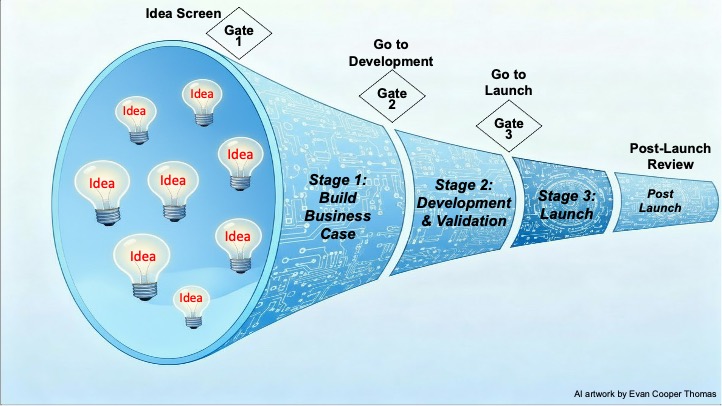
Figure 1. The new Stage-Gate-Agentic, accelerated and compressed to just 3 stages by using AI agents for both Stages and Gates
Stage 1 – Build Business Case: AI tools can already perform most tasks required to create a robust business case. In Stage-Gate Agentic, multiple tools operate within a coordinated agentic system to:
- identify market gaps and generate product concepts,
- analyze market trends and competitors,
- synthesize VOC insights using sentiment mining, synthetic personas, or simulated interactions,
- conduct technical feasibility assessment, risk identification, and capability analysis,
- perform virtual prototyping and scenario testing,
- evaluate regulatory compliance and IP issues, and
- model financials including revenue forecasts, profitability, NPV, IRR, and payback.
An integration agent compiles these into a comprehensive business case. What once required weeks of cross-functional work can now be completed in hours or days at minimal cost, providing a rich foundation for Gate 2.
Gate 2, Go to Development, assesses this business case. Tools, such as AI-PRISM,[12] already demonstrate how AI can evaluate opportunities, search for missing data, rate projects against proven criteria, and recommend go/kill decisions. But because this gate commits significant resources, human oversight remains essential, especially for strategic alignment, risk appetite, and portfolio balance. In the near term, Gate 2 will be AI-assisted rather than autonomous.
Stage 2 – Development and Validation: In Stage 2, AI agents will increasingly act as integrators—linking multiple AI-driven tasks into a single, seamless product-development flow. For engineered products, instead of today’s patchwork of disconnected steps, AI will unify engineering design, simulation-based optimization using digital twins, automated creation of 3-D printed prototypes, and even early customer trials conducted with product digital twins. These activities will operate as an integrated loop, with each informing the other in real time.
This vision is realistic: Companies like Siemens, Dassault, GE, and Autodesk are building integrated platforms where design → simulation → optimization → prototype → testing operate in a continuous loop.[13] AI agents will make these platforms autonomous and self-coordinating. Fully functional implementations are likely within 5–10 years, although leading companies are already piloting individual components or running partial agentic cycles.[14]
In Stage 2 for materials, chemicals, and pharmaceutical products, AI agents have the potential to orchestrate an end-to-end development pipeline. The agent can generate candidate molecules or materials based on desired properties, run in silico simulations to predict performance, stability, or toxicity, and select the most promising candidates. It can then program AI-operated robotic laboratories—such as the Unilever UK facility—to synthesize these candidates and conduct preliminary testing. Experimental results feed directly back into the AI system, which analyzes outcomes, refines candidates, and iterates the cycle. By integrating design, simulation, synthesis, and testing into a continuous, automated workflow, the AI agent dramatically accelerates early-stage development, reduces human effort, and enables rapid learning across multiple candidates.
This approach is already partially feasible with existing computational chemistry, material informatics, and robotic lab platforms. Fully integrated agent orchestration is likely within 5–7 years for leading companies, with broader adoption in 7–10 years.
Gate 3 – Go to Launch evaluates whether the fully developed and tested product is ready for market. AI agents can provide detailed readiness checks—product performance, cost, manufacturing scalability, regulatory compliance, and market conditions—while humans still handle the final judgment on timing, business value, and investment risk.
Stage 3 – Launch & Post-Launch: Stage 3 encompasses full market introduction, including production ramp-up. While humans remain central to manufacturing and commercial activities, AI agents increasingly support:
- forecasting and demand planning,
- dynamic pricing,
- inventory optimization,
- salesforce planning and management,
- marketing communications, and
- customer service interactions and early-market feedback.
Post-launch, AI-driven analytics continuously monitor product performance in real time, identifying issues and enabling rapid corrective actions. Once the product has stabilized in the market and performance metrics are met, the project is formally closed, marking the end of the team’s accountability while retaining the lessons learned for future initiatives.
The Human Role
Humans do not disappear in the Stage-Gate Agentic world; instead, their roles transform. Project teams become orchestrators of AI agent systems. They define objectives, monitor agent and AI model performance, validate outputs, and apply contextual judgment—especially when AI recommendations conflict with experience or strategic factors. Project leaders act as conductors, coordinating specialized agents, ensuring information flow, and representing the project at gates. Skills shift from execution and scheduling to AI orchestration, system literacy, and strategic synthesis.
The gate management decision-makers at gates or “gatekeepers” remain crucial. They validate whether analyses are plausible, challenge AI-generated recommendations, and consider broader strategic questions beyond the AI model’s scope. Human-in-the-loop frameworks help ensure decisions are reliable, ethical, and aligned with organizational priorities.
Management Implications
Stage-Gate Agentic is not a minor process improvement—it represents a rethinking of how new products are conceived and executed. The move to a three-stage framework reflects the declining cost of gathering and synthesizing information. Gate decisions shift from verifying detailed homework and reviewing gate deliverables to confirming business value , strategic fit and risk exposure.
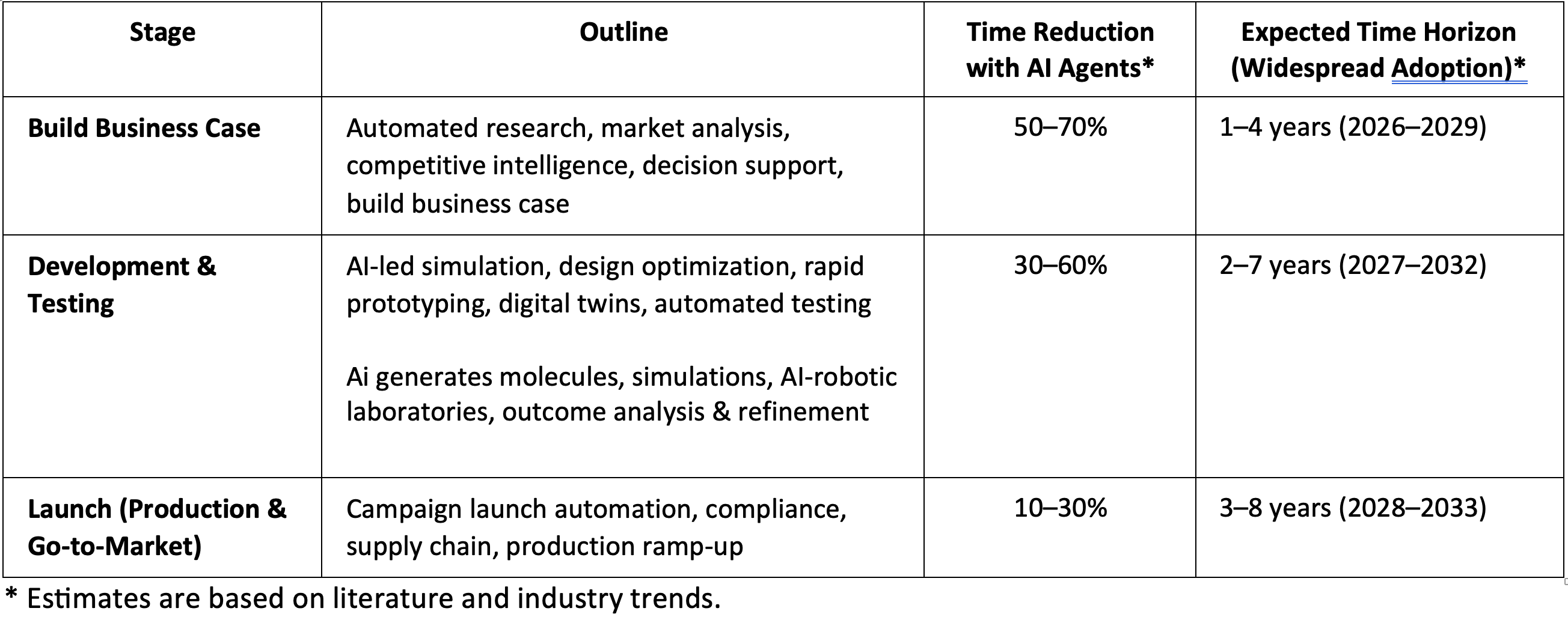
The impact is substantial, and the timing is imminent (see Table 1):
Table 1: Stage Impact and Timing Estimates
Organizations that adopt agentic NPD early will benefit from:
- Much faster cycle time—stages completed in hours or days.
- Higher decision quality via comprehensive AI-driven analysis.
- Smaller project teams with clearer strategic roles.
- Lower development costs through automation and simulation.
- More reliable and consistent evaluations.
Success with Stage-Gate Agentic requires new organizational competencies, however: AI orchestration skills, governance for autonomous systems, mechanisms to build trust in AI’s outputs, and clarity on where human judgment adds value.
Conclusion
The future of NPD is a partnership between humans and AI agents. AI systems perform information-intensive tasks—research, analysis, simulation, and integration—while humans provide strategic vision, contextual insight, and final accountability. Stage-Gate Agentic provides a framework for harnessing this partnership, enabling faster, more efficient, and more competitive innovation in an AI-driven era.
About the Author
Dr. Robert G. Cooper is Professor Emeritus at McMaster University’s DeGroote School of Business (Canada); ISBM Distinguished Research Fellow at Pennsylvania State University’s Smeal College of Business Administration; Honorary Advisor, Snyder Innovation Management Center, Syracuse University; and a Crawford Fellow of the Product Development and Management Association (PDMA).
Bob is the creator of the popular Stage-Gate® process model, now the most popular idea-to-launch NPD process globally (for physical product firms). He is also co-founder of Stage Gate International Inc. Bob has published 12 books – including the “bible for NPD”, Winning at New Products, and more than 160 articles on the management of new products, including 17 refereed articles on “AI in NPD” in 2023 – 25. He has won the IRI’s (Innovation Research Interchange) prestigious Maurice Holland Award three times for “best article of the year”.
Bob has helped hundreds of firms over the years implement best practices in product innovation, including many Fortune 500 firms. Cooper holds Bachelor and Master’s degrees in chemical engineering from McGill University in Canada; and a PhD in Business and an MBA from Western University, Canada.
Website: www.bobcooper.ca
Contact: robertcooper@cogeco.ca
References:
[1] Robert G. Cooper, “The 5-th Generation Stage-Gate Idea-to Launch Process,” IEEE Engineering Management Review, (50), 4 (Dec. 2022): 43–55. DOI: 10.1109/EM and I had to. Somebody mentioned this to me the other day, R.2022.3222937. Link: https://bobcooper.ca/articles/next-generation-stage gate-and-whats-next-after-stage-gate
[2]. A. Zarei and R. Faridnia, “AI-Based Expert System Framework for Product development Stage-Gate Decisions,” Journal of Advances in Civil and Mechanical Engineering. (Aug. 31, 2024). DOI: 10.22541/au.172508711.18322357/v1.Link: https://doi.org/10.22541/au.172508711.18322357/v1
[3 ] IBM, (2025). “What is Agentic AI?” IBM Think. Link: https://www.ibm.com/think/topics/agentic-ai
[4] McKinsey & Company, “What is an AI Agent?” March 25, 2025). Link: https://www.mckinsey.com/featured- hi colleen insights/mckinsey-explainers/what-is-an-ai-agent
[5 ] L. Mantia, S. Chatterjee, and V.S. Lee, “Designing a Successful Agentic AI System,” Harvard Business Review. (Oct. 24, 2025 ). Link: https://hbr.org/2025/10/designing-a-successful-agentic-ai-system
[6 ] Y. Ren, Y. Liu, T. Ji, and X. & Xu, “AI Agents and Agentic AI: Navigating a Plethora of Concepts for Future Manufacturing,” Journal of Manufacturing Systems, 83 (2025): 126–133. Link: AI Agents and Agentic AI–navigating a plethora of concepts for future manufacturing - ScienceDirect
[7 ] Chris Daigle, “How P&G Used AI to Cut Product Development Time by 22%,” ChiefAIOfficier.com. (Sept. 21, 2025), link: How P&G Used AI to Cut Product Development Time by 22% - CAIO_Blog2025
[8 ] April Miller, “16 Companies Using Generative AI for Business Efficiency,” InData Labs (Nov. 6, 2025). Link: https://indatalabs.com/blog/companies-using-generative-ai
[9 ] Hardik Makadia, “15 Best Agentic AI Companies of 2025,” Wotnot. (Nov. 5, 2025). Link: https://wotnot.io/blog/best-agentic-ai-companies
[10 ] Microsoft, “RD-Agent: An Open-Source Solution for Smarter R&D,” Microsoft Research Lab – Asia. (Jan. 6, 2025). Link: https://www.microsoft.com/en-us/research/articles/rd-agent-an-open-source-solution-for-smarter-rd/
[11 ] Robert G. Cooper, Winning at New Products: Creating Value Through Innovation, 5th edition, New York, NY: Basic Books, Perseus Books Group (2017).
[12 ] Robert G. Cooper, “AI-PRISM: A New Lens for Predicting New Product Success,” PDMA kHUB 2.0 (Feb. 28, 2025. Link: AI-PRISM: A New Lens for Predicting New Product Success - Knowledge Hub 2.0
[13] Andy Harris, “Reimagining Assembly Design with Agent AI: A New Paradigm for Intelligent Systems,” Autodesk University, Australia (2025). Link: Reimagining Assembly Design with Agent AI: A New Paradigm for Intelligent Systems | Autodesk University
[14] Mesh Flinders and Ian Smalley, “AI in Product Development,” IBM Think (Nov. 20, 2025). Link: AI in Product Development | IBM