From Applied AI to Practical Business Use: Why Commercialization Infrastructure Matters
How early-stage AI companies can help B2B customers move from interest to adoption, implementation, and measurable value
Rebecca Park
kHUB post date: May 2026
Read time: 10 minutes
Executive Summary:
Applied AI technologies are advancing quickly, but many early-stage AI companies still struggle to turn technical capability into practical business adoption. This article focuses on B2B applied AI companies that sell AI products or services to business customers, especially small and mid-sized businesses. In this context, “customers” refers to the organizations buying or adopting the AI product, and “implementation” refers to the work required to integrate that product into real workflows, onboard users, build trust, and measure business value.
The issue is not always whether the technology works. More often, the challenge is whether customers can understand it, trust it, implement it, and measure value from it. This is why commercialization and implementation infrastructure are essential.
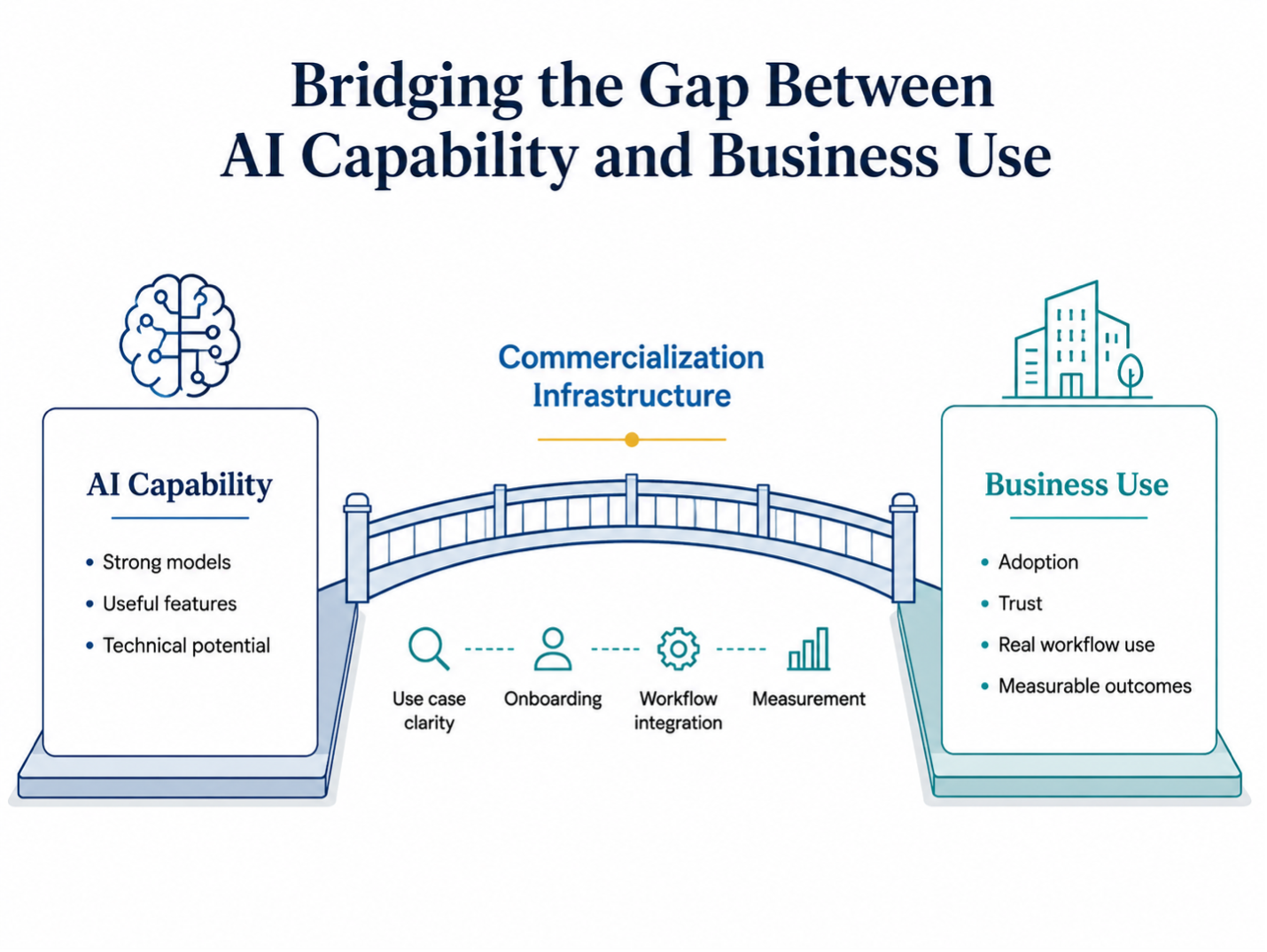
Introduction: The Gap Between AI Capability and Business Use
While much of the AI adoption conversation focuses on large enterprises adopting general-purpose AI tools, this article focuses on a different but closely related challenge: how early-stage applied AI companies can help B2B customers, particularly SMBs, bring AI products into practical use.
Applied AI has moved quickly from technical experimentation into mainstream business strategy. Companies are investing in generative AI tools, predictive analytics, automation platforms, copilots, and vertical AI applications with the expectation that these technologies will improve productivity, reduce operational friction, and create measurable business value.
Yet outcomes remain uneven. McKinsey’s 2025 State of AI survey found that while more than three-quarters of respondents say their organizations use AI in at least one business function, most organizations still have not seen enterprise-wide, bottom-line impact from generative AI. More than 80 percent of respondents reported that their organizations were not seeing a tangible enterprise-level EBIT impact from gen AI use. The same report found that workflow redesign was the factor with the largest effect on whether organizations saw EBIT impact, yet only 21 percent of organizations using gen AI had fundamentally redesigned at least some workflows.
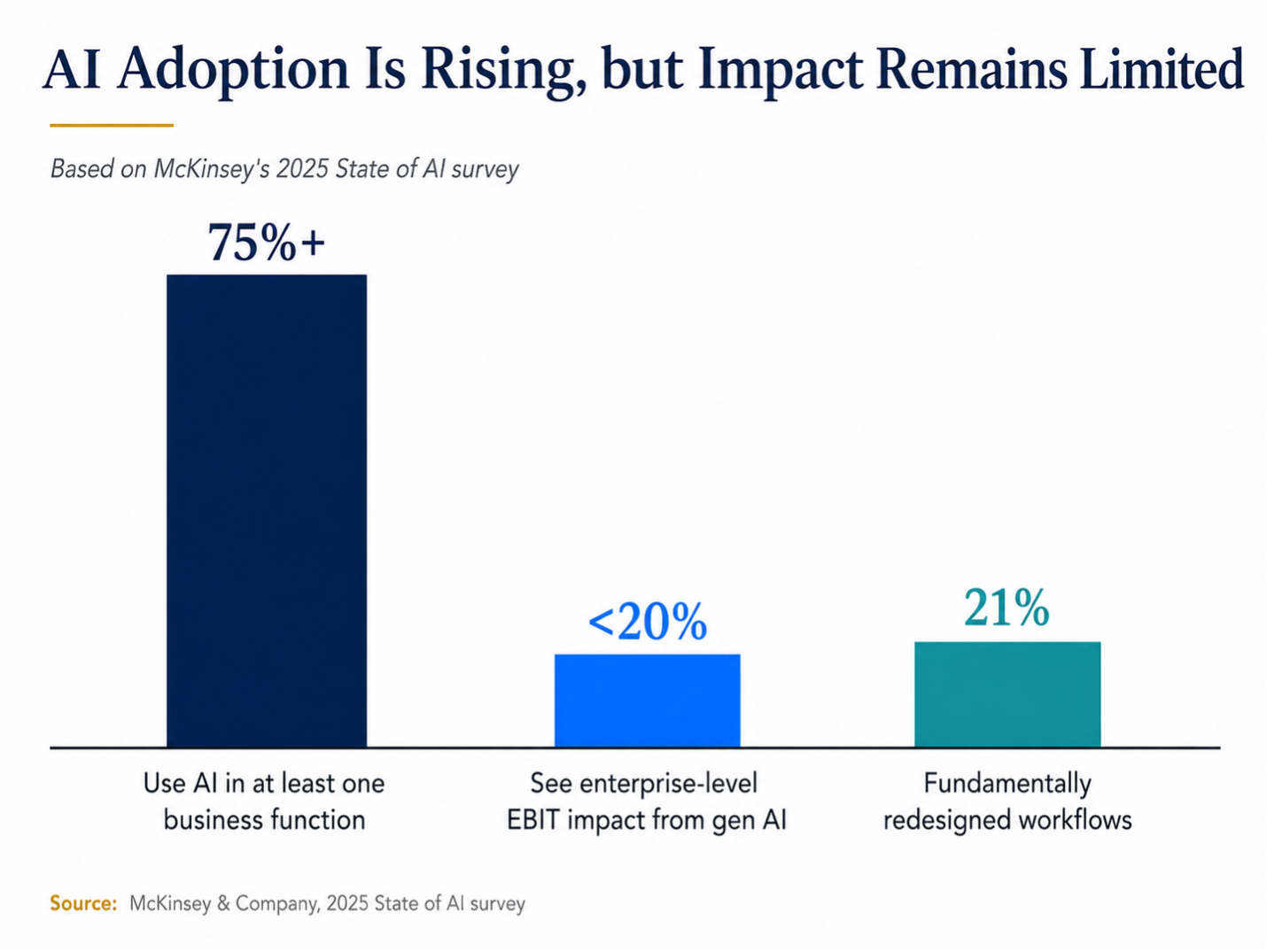
This suggests that the core challenge is not simply access to AI capability. It is the discipline of turning that capability into operational change. AI products may perform well in a controlled demo, but fail to become part of a customer’s daily workflow. A tool may save time in theory, but remain unused if the customer does not know where it fits, who should own it, or how success should be measured. A platform may generate useful insights, but fail to convert into revenue if the business case is unclear.
This pattern is not unique to AI. Product innovation research has long shown that technical performance alone does not determine commercial success. Robert G. Cooper’s work on AI and new product development notes that AI adoption in product innovation remains constrained by barriers such as a weak business case, high perceived costs, lack of organizational readiness, and implementation uncertainty.
This is where the distinction between AI capability and business use becomes important.
AI capability asks:
Can the technology perform the task?
Business use asks:
Can the customer understand it, trust it, implement it, and measure value from it?
The second question is often harder. It requires not only product quality, but also market translation. It requires a system for helping customers move from interest to adoption, and from adoption to measurable value.
Recent PDMA discussions around AI strategy have emphasized that technical progress alone does not guarantee business impact. The referenced PDMA Knowledge Hub article, for example, frames the challenge as moving from AI capability to strategic business outcomes, with adoption, trust, differentiation, and ROI mattering more than technical progress alone.
This article builds on that broader idea, but focuses on a more specific layer: the commercialization and implementation infrastructure needed to bring applied AI technologies into practical business use.
Many early-stage AI companies can generate initial interest through demos and sales conversations, but practical business use requires more than interest. It requires a repeatable system for helping customers identify the right use case, integrate the product into their workflow, experience early value, and measure outcomes. For early-stage B2B AI companies, commercialization infrastructure is the system that helps customers reach their first meaningful success with the product.
The Gap Between Capability and Use
A strong AI product can still fail commercially if customers do not know where it fits into their daily operations. A tool may look impressive in a demo, but if the customer cannot connect it to a clear workflow, business outcome, or return on investment, adoption will remain limited.
This gap is especially visible among small and mid-sized businesses. Many SMBs, as customer organizations, are interested in AI but lack the internal resources to evaluate tools, redesign workflows, train employees, or measure results. At the same time, early-stage AI companies may have technically strong products but limited systems for translating those products into clear use cases, repeatable customer success, and sustainable revenue.
Customer service AI is a useful example. Products such as Intercom’s Fin show that the value of an AI agent does not come only from its ability to answer customer questions. Consider a small professional services firm adopting a customer service AI agent to reduce repetitive support inquiries. The product may be technically capable of answering questions, but the firm still needs to connect it to the right knowledge base, define which inquiries the AI should handle, decide when a human agent should step in, test the experience before launch, and measure whether it improves response time, resolution rate, customer satisfaction, or support cost.
In this case, the barrier is not simply AI capability. The barrier is implementation. The AI company must help the customer define use cases, design escalation rules, onboard support staff, build trust in the system, and track whether the product is creating measurable operational value. Without this commercialization and implementation layer, even a technically strong AI product may remain underused.
Gate 2 is a difficult investment decision because often the information in the business case is uncertain and fluid. History has shown that managers in NPD facing similar decisions with uncertain information get less than 50% of the decisions correct [16]; thus, a more structured decision approach should be used here, such as the SPARK Scorecard in Table 3 [17]. The lea
What Commercialization Infrastructure Means:
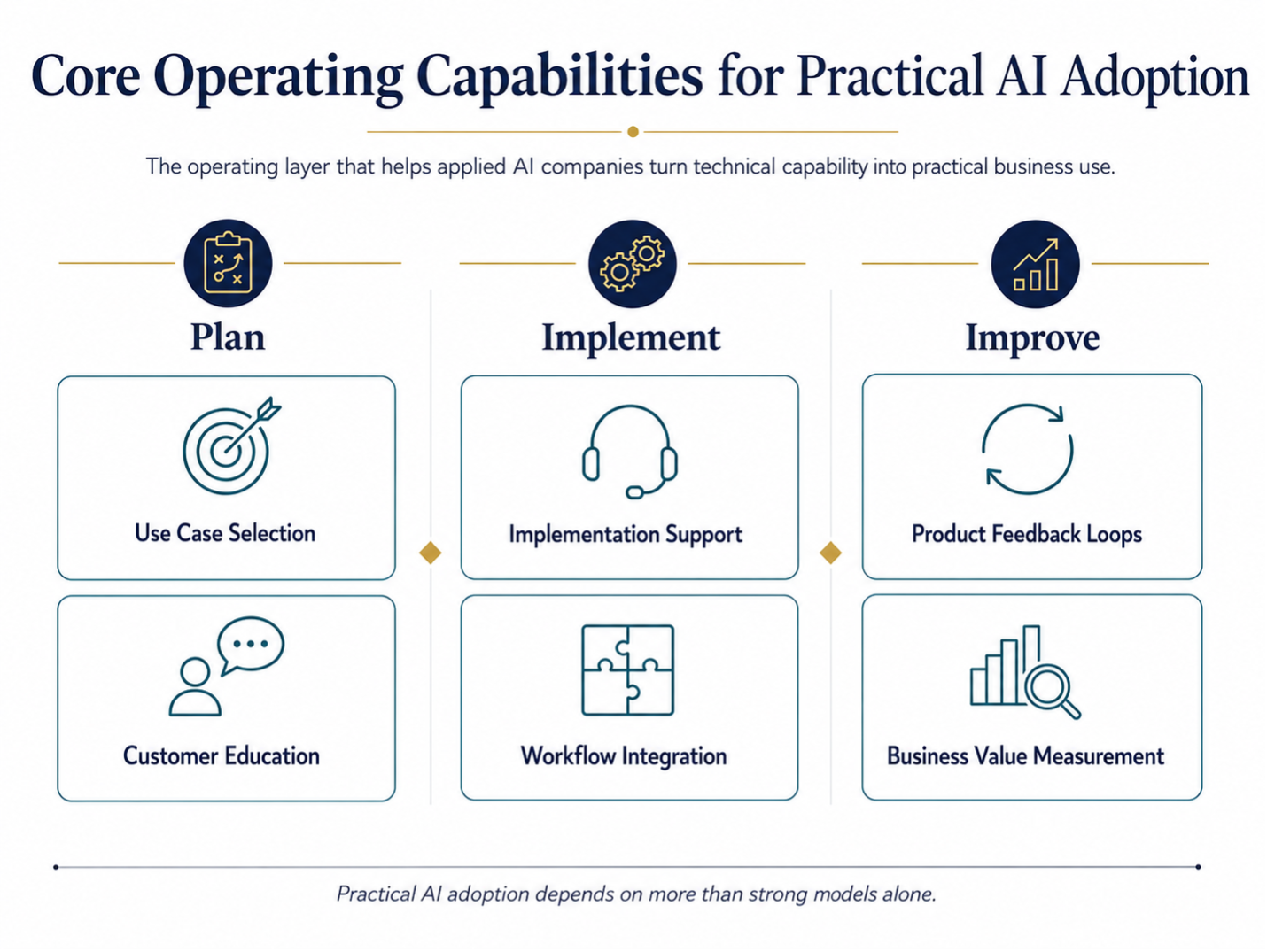
For B2B applied AI companies, commercialization infrastructure should not be treated as only sales or marketing. It is the operating layer that helps customer organizations move from interest to actual use.
This includes defining the right use case, explaining the product’s value in business terms, educating buyers and end users, supporting onboarding, integrating the tool into existing workflows, creating feedback loops between customers and product teams, and measuring whether the product is producing real business outcomes.
Without this layer, even strong AI products can remain experimental rather than essential. For example, customer confusion during onboarding may not simply be a support issue. It may reveal that the product’s value proposition is unclear. Repeated objections during sales conversations may not simply be a sales challenge. They may point to a missing use case, weak customer education, or lack of trust in the product’s output.
Why It Matters for AI Companies and SMBs
The commercialization gap affects both sides of the market.
For early-stage AI companies, weak commercialization infrastructure can delay product-market fit and make it harder to achieve commercial viability. A company may build a capable product, but still struggle to reach the right customers, communicate value, activate users, and turn feedback into product or messaging improvements.
This is especially important because early-stage companies often operate with limited resources. They may not have separate teams for product marketing, customer success, implementation, sales enablement, and market research. As a result, valuable customer signals can remain scattered across sales calls, support conversations, demo feedback, and onboarding issues. Without a system for capturing and translating those signals, the company may continue improving the technology without improving adoption.
For SMBs, the challenge is different but connected. Many smaller businesses do not have dedicated AI, data, or innovation teams. They need clearer adoption pathways, lower implementation friction, and more practical guidance on how AI can improve specific business outcomes.
An SMB may be interested in AI but still struggle with basic implementation questions: Which use case should come first? How much process change is required? How should customer success be measured? What level of human oversight is appropriate?
These are not minor details. They often determine whether an AI product becomes part of the business or remains a disconnected experiment.
This is why commercialization infrastructure has a two-sided value. It helps AI companies translate technical products into market-ready solutions, and it helps SMBs adopt those solutions in ways that are understandable, practical, and measurable.
From Product-Market Fit to Product-Market Implementation:
For applied AI, product-market fit may not be enough. Companies also need what could be called product-market implementation: the ability to help customers use the product effectively in real business conditions.
Product-market fit asks whether the market wants the product. Product-market implementation asks whether the market can actually operationalize it.
This is especially important for AI products because adoption often requires changes in workflow, employee behavior, trust, and decision-making, not just software installation.
This distinction matters because many AI products require some level of behavior change. A customer may believe the tool is valuable, but still fail to adopt it if the workflow is unclear. A buyer may understand the potential ROI, but hesitate if the implementation burden feels too high. A user may try the product once, but not return if the output is difficult to interpret or apply.
Often, it is the lack of a repeatable system for helping customers understand, implement, and measure the technology in practice.
Many early-stage AI companies make the mistake of moving too quickly toward leads, demos, and revenue before creating small but meaningful customer success cases. The problem is not that growth is unimportant. The problem is that growth becomes fragile when the company has not yet learned why customers succeed, why they fail, and what kind of onboarding or workflow support turns interest into repeated use.
For AI products, early growth does not come only from generating demand. It comes from helping customers understand how to use the product, experience value quickly, and feel confident enough to continue using it. Before scaling aggressively, AI companies need to create small success cases, understand why those customers succeeded, refine onboarding around those lessons, and build a repeatable system from the ground up.
This is especially important for small and mid-sized businesses. These customers are already busy running their companies. They usually do not have the time to spend two weeks studying a complex product, redesigning their workflow, or figuring out use cases on their own. If the product cannot guide them toward an early and simple use case, onboarding becomes difficult. Even if the product is technically powerful, customers may leave before they ever experience its value.
Another common problem is a lack of strategic direction around the first use case. Some companies focus too heavily on broad positioning or competitor comparison before clearly defining what specific customer problem they solve best. Without a clear initial use case, the company may generate attention but fail to create lasting customer commitment.
A high number of leads does not automatically mean product-market fit, customer satisfaction, or long-term adoption. If customers come in but quickly drop off, the company has created interest, but not durable adoption.
In other words, sustainable AI commercialization requires more than selling the product. It requires helping customers reach their first meaningful success with the product. Only after those early success cases exist can a company build stronger adoption, clearer positioning, and more reliable revenue growth.
Conclusion
The next stage of applied AI adoption will depend not only on better models or more advanced features. It will depend on stronger pathways that help customer organizations understand, implement, and measure AI in practice.
Successful AI commercialization is not just about bringing a product to market. It is about building the infrastructure that helps technology become part of how customer organizations actually operate.
ABOUT THE AUTHOR
Rebecca Park is a commercialization and go-to-market professional with experience helping emerging technology companies bring innovative products to market. Across three AI startups, she was the first go-to-market hire, holding founding account executive roles and helping build early customer traction, refine market positioning, and establish repeatable growth processes.
She currently serves as the B2C lead for a legal technology platform used by over 2.5 million users, where she leads initiatives across partnerships, user acquisition, and funnel optimization. Rebeccaholds a bachelor’s degree in International Studies from Penn State University and is particularly interested in product innovation, commercialization, and applied AI adoption.
LinkedIn: https://www.linkedin.com/in/rebeccaseohyeonpark/