AI‑Powered Stage‑Gate: Supercharging Your Idea‑to‑Launch Process
Dr. Robert Cooper
kHUB post date: April 30, 2026
Read time: 10 minutes
Artificial intelligence (AI) is transforming how firms conceive, develop, and launch new products. Yet the core challenge for senior management has not changed: how to make better innovation decisions under uncertainty—faster, and with fewer resources. Stage‑Gate® was built for that challenge.
“Hardly a day goes by without customers asking us how digital and AI capabilities should intersect with their new product development processes, and specifically with Stage‑Gate.”
Robert Olsen, VP Business Development and Strategic Partnerships, Albert Invent
Properly understood, AI is a powerful augmentation of Stage‑Gate’s logic. It becomes the always‑on analyst inside each stage and the extra (non‑voting) gatekeeper at every gate, improving facts, forecasts, and decisions while humans still own strategy and accountability. Stage‑Gate and AI are natural complements: the basic governance architecture of Stage‑Gate remains intact, but the richness, speed, and reliability of the information flowing through the process—and the quality of the conversations at the gates—change dramatically.
Stage-Gate’s Job in an AI World
Stage‑Gate was introduced to bring direction to innovation: structured information gathering, explicit criteria, and robust go/kill decisions at defined points in a project’s life. The core idea is simple: break the innovation journey into stages of work, separated by gates where management decides whether to commit further resources, based on predefined criteria, evidence, and a cross‑functional review (Figure 1). These incremental steps—spend a bit, gather information, then decide—are not unlike buying a series of options on an investment property; the process mitigates risk [1].
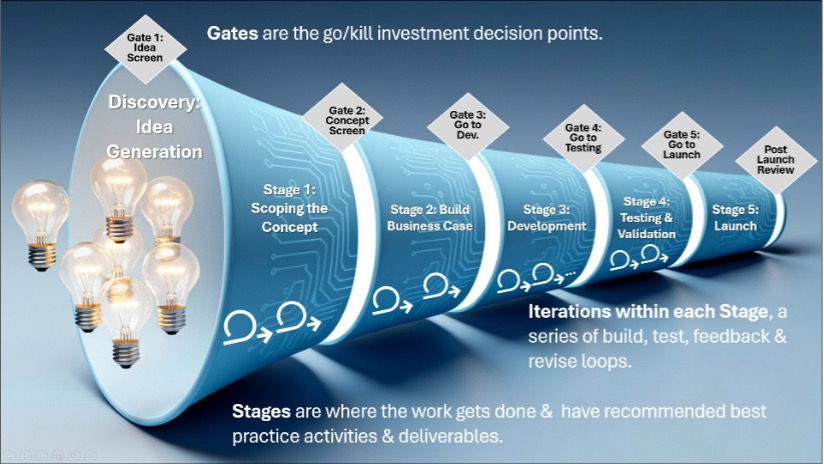
Figure 1: The Stage-Gate® model with five stages – where the work gets done—and five gates—where the go/no go investment decisions are made. This five-stage model is for major new product projects.
Stage‑Gate’s job description has not changed. What has changed is the world around it. Markets move faster, technologies are more complex, and data are overwhelming in both volume and variety. In this environment, the bottleneck is no longer access to information, but the ability of human teams to process and interpret it. AI addresses that bottleneck. It does not change Stage‑Gate’s purpose; it changes what is feasible within each stage and how well‑informed each gate can be.
AI supercharges Stage-Gate by making every major judgment—technical, market, and financial—more predictive, data‑rich, and continuous rather than episodic. Leading firms report up to 50 percent reductions in development time when AI tools are used, foreshadowing what an AI‑powered Stage‑Gate can deliver [2].
AI tools excel at prediction, pattern recognition, and natural language processing, which maps almost perfectly to the core tasks in Stage‑Gate: understanding customers, sizing opportunities, optimizing and testing designs, forecasting outcomes, and choosing between alternatives. In the emerging “AI agentic” version of Stage‑Gate, AI agents even orchestrate full stages and semi‑automate gates, compressing activities that once took weeks into hours while still keeping human judgment in control [3].
The Digital Foundation: Structured Data, Simple Templates
Before talking about “AI in Stage 3” or “AI at Gate 2,” you need a prerequisite: clean, structured project data. Most organizations still house project information in slide decks, Word files, and scattered spreadsheets—formats designed for human eyes, not for analytical engines.
A practical first step is to standardize core templates for key deliverables:
- Idea statementss
- Market, technical, IP and legal assessments
- Product definition and requirements
- Financial analysis and risk profiles for different gates
- Engineers, lab, and product testing descriptions and results
- Launch plans and post-launch reviews
These templates should have clearly defined fields, consistent scales, and drop‑down options where possible. The goal is not more bureaucracy, but to capture information that teams would produce anyway, but consistently and in a simple, easy‑to‑use form that can be aggregated into a single digital file for each project, and then across the portfolio. When AI tools gather the information and write the documents (such as a market analysis), they can be programmed to deliver the reports in templated format.
Idea Generation and Discovery (Pre-Gate 1)
At the very front end, AI turns the fuzzy, ad‑hoc search for opportunities into a more systematic and scalable activity [4]. Gen AI and other AI tools can continuously mine patents [5], technical literature, social media, review sites, and customer feedback to surface unmet needs, weak signals, and “white spaces” for innovation (see Table 1).
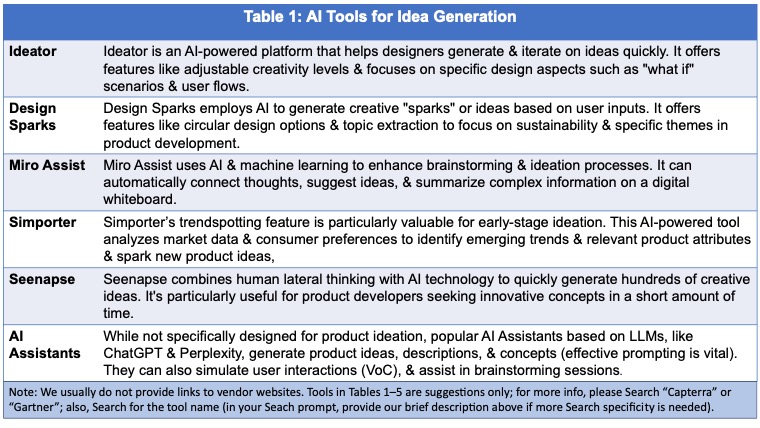
For example, AI‑augmented front‑end platforms reduce the time required to analyze customer sentiment and prioritize features; and Gen AI ideation tools, such as Ideamap, produce a high volume of relevant and reasonably novel ideas aligned with problem statements, which project teams then combine into robust product concepts.
Importantly, even low-cost AI platforms like ChatGPT and Perplexity Pro, create novel and focused ideas when given the right prompts [6].
Stage 1 Scoping: Faster and Better with AI
In Stage 1, traditional teams often perform a quick scoping study—light market scan, rough technical check, and preliminary financials—based largely on desk research and internal know‑how. AI compresses this work dramatically by generating concise summaries of markets, competitors, and technologies from vast external and internal sources [7, 8]. (While this article is for the development of physical products, it also applies to software development, especially in the earlier stages).
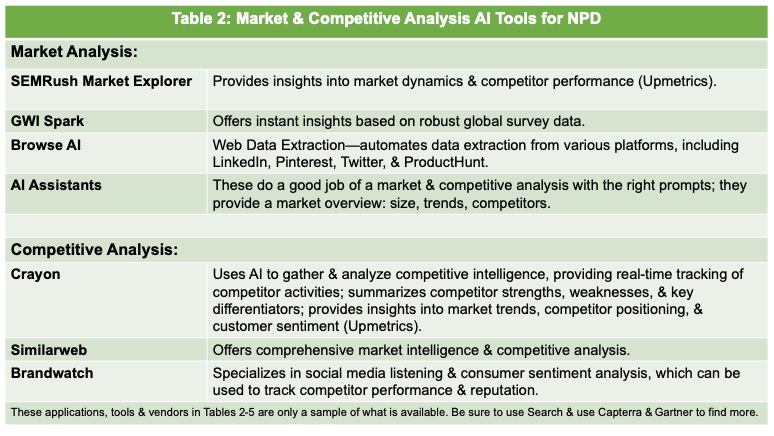
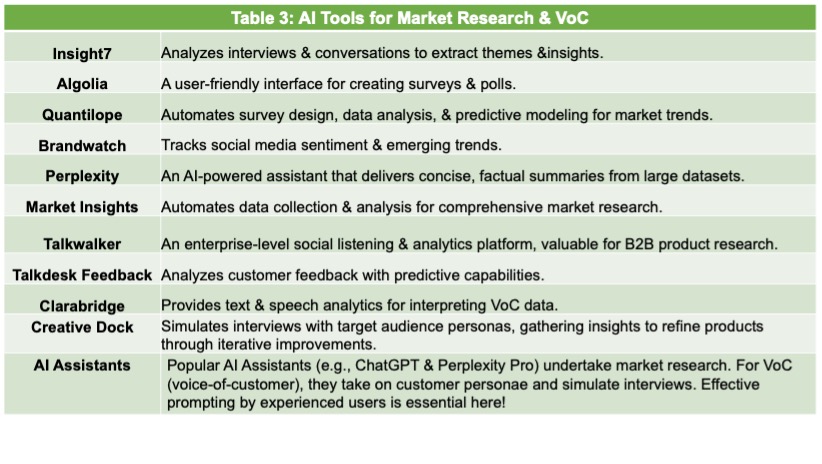
Natural‑language tools scan large volumes of unstructured text—customer reviews, discussion forums, complaints, social media, and news—to extract recurring themes, unmet needs, and usage contexts. Competitive‑intelligence engines monitor rivals’ product launches, pricing moves, patent filings, and even hiring patterns, condensing them into concise snapshots (see Tables 2 and 3 for sample AI tools).
Gen AI tools will also conduct many of the needed analyses, using both internal data supplied by the team and by doing online searching of numerous external sources. For example, Perplexity Pro has done superb preliminary market and technical assessments for many of our projects, certainly more than is sufficient for Stage 1 of Stage-Gate1.
Stage 2: AI as the Information Workhorse
Stage 2—the business case and project definition—is where Stage‑Gate and AI fit together most visibly. Many activities that teams struggle to do well or on time are exactly where AI is strongest. Not surprisingly, major weaknesses in new‑product projects are often found in this “front‑end homework” stage.
Market and Voice‑of‑Customer (VoC) research: GenAI, properly prompted, can undertake a comprehensive market scan and draft a structured market‑analysis report. Text‑mining tools ingest customer feedback from multiple channels—reviews, call‑center transcripts, service logs, surveys—and categorize needs, pain points, and desired features. Firms also employ “synthetic VoC”, where AI models adopt the personae of different customer segments and simulate interviews to determine needs (see Tables 2 and 3 for sample AI tools).
Technical Assessment and risk analysis: With the right prompts, GenAI (Chat-GPT or Perplexity Pro) is usually excellent at technical assessment for Stage 1—it can define the product technically, that is, describe the likely technical solution. It also pinpoints the key technical risks, identities possible solutions to technical challenges, and suggests mitigating strategies.
Software from AI vendors produces design explorations and alternatives, risk maps, and structured mitigation strategies. AI can also help generate and critique FMEA tables and hazard analyses, drawing on past projects and external failure data. The result is that detailed technical assessment, appropriate for Stage 2, is based on more than expert opinion and a few meetings.
Competitive and IP Analyses: Competitive and intellectual‑property analyses are natural AI applications. Specialized engines scan patent databases, standards, and technical literature to map “white spaces” and crowded regions in a technology domain. They flag potential freedom‑to‑operate issues and identify adjacent technology areas where competitors are active. They also provide ample competitive information—about their products, strategies, and pricing, as shown in Table 2.
Creating the Business Case
Stage 2 continues by sharpening the product concept and then crafting the business case. Here, Generative AI can draft multiple alternative value propositions and product narratives tailored to different segments, which the team can test and refine.
AI‑enhanced concept testing—using rapid product simulations and automated analysis of open‑ended responses—identifies which features and benefits drive interest for which segments [9]. AI can even undertake the concept tests by creating simulated user personae, conducting the interviews, and producing concept test results—in minutes, not weeks [3]!
Predictive market models combine historical sales, web behavior, macro indicators, and social data, to forecast likely demand and price bands, allowing managers to explore scenarios [10]. And predictive AI success/failure models yield the likelihood of new product success, based on historical success drivers [11].
AI also analyzes various market and financial data points to generate financial models, predict NPV, and optimize pricing strategies. AI tools exist that will even write the business case, using prompts along the way (for example, Upmetrics, 15MinutePlan, and My Business Case Hub®). Firms already use AI to build more robust financial projections and portfolio simulations, automatically running sensitivity analyses and providing risk bands around NPV or payback rather than a single point estimate.
In advanced Stage‑Gate Agentic implementations, an AI agent or “orchestra leader” performs much of Stage 2’s analytical heavy lifting—gathering the data, running models, and preparing a structured business‑case dossier. One AI agent even completes Stage 2 for a typical new product in about 2-3 hours, including iterations with the project team [3].
Development (Stage 3)
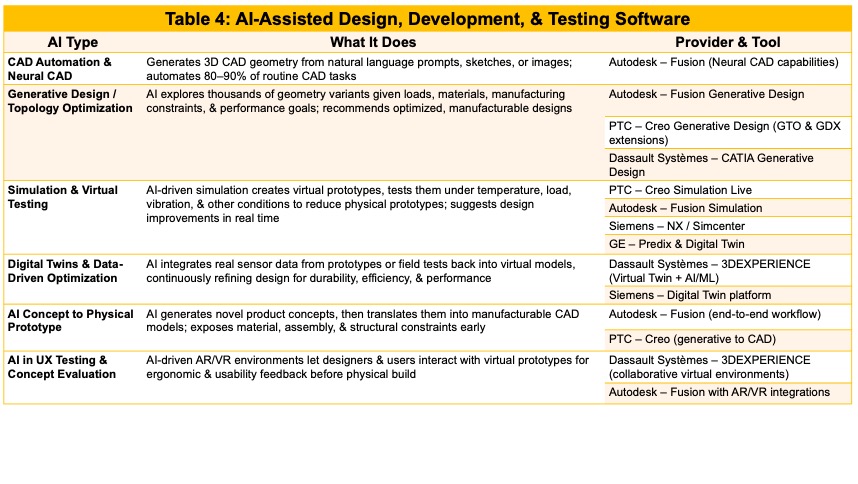
Development is where AI's impact on technical and project work becomes most visible. In engineering‑intensive industries, AI‑enhanced simulation, optimization, and digital twins let teams try many more design options virtually, test them under realistic conditions, and converge on better solutions with far fewer physical prototypes. Manufacturers report that using digital twins in this way has cut development time by 20–50 percent and reduced pre‑production prototype builds from several rounds down to a single prototype in some cases [12,13] (see Table 4 for sample tools).
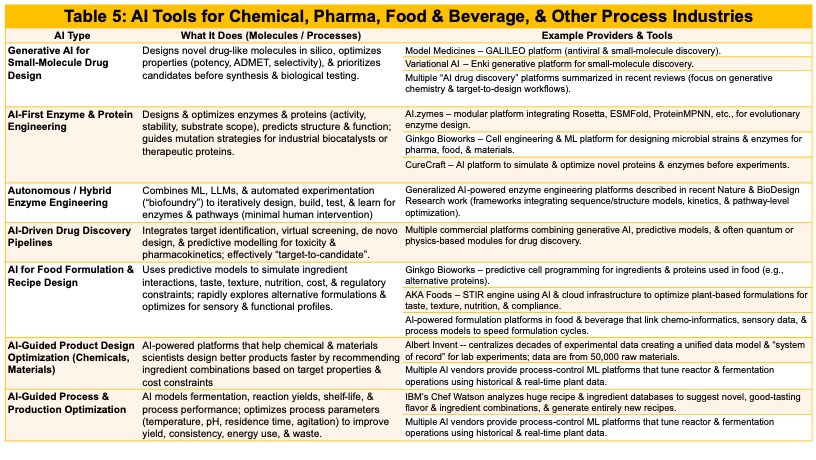
In chemical, pharma, and process industries, AI‑guided design narrows the search space for new molecules, catalysts, or formulations, prioritizing experiments likely to yield useful results [14,15] (see Table 5).
Project management is increasingly where AI earns its keep. AI‑enabled tools continuously scan project data and learn from past projects to detect emerging schedule slips and resource bottlenecks, rather than waiting for status reports to go red. These systems surface early‑warning signals—such as repeated requirement changes, growing rework, or recurring supplier and approval delays—and suggest mitigations like rescheduling, rebalancing workloads, or simplifying workflows, so teams can intervene before delays and overruns become entrenched [16,17].
Testing and Validation (Stage 4)
Testing and validation are inherently data‑intensive, making them ideal candidates for AI augmentation. AI helps design better tests (what to test, with whom, and at what scale), extract more insight from each data point, and feed learning back into models that update risk and success estimates [18].
Machine‑learning models can analyze pilot and beta data to identify which customer segments perform best, where performance is unstable, or what conditions trigger failures. Natural‑language processing tools can rapidly process qualitative customer feedback from field trials and online discussions, turning thousands of comments into structured insights on pain points, desired features, and emotional reactions. In some industries (for example, chemicals and pharma), AI is already used to design and test molecules and reactions virtually, reducing the number of lab experiments required.
By the time a project reaches Gate 5, gatekeepers have not just seen pass/fail test results but a continuously updated statistical picture of performance, variability, and likely market response. This allows more nuanced go/hold/kill decisions and more targeted remediation plans when issues remain.
Launch and Beyond
Stage 5 is traditionally where marketing, sales, and operations synchronize to get the new product into the hands of customers. In operations and market launch, AI‑driven demand forecasting and supply‑chain analytics help firms ramp up production and distribution more smoothly, and enable better production planning and inventory management.
In marketing and sales, AI models support pricing, promotion targeting, and salesforce planning, tailoring go‑to‑market strategies to specific customer segments. Optimizing marketing plans, from pricing to MarCom, and operations and source-of-supply management are huge topics with many AI-tools available; they are beyond the scope of new product development (NPD) and this article, however—see [19] and [20].
Post‑launch, AI helps firms do what Stage‑Gate always recommended but few executed consistently: rigorous, evidence‑based post‑launch reviews. Usage data from IoT of data digital twins, connected products, service logs, and customer feedback can be mined continuously to identify performance issues, unmet needs, and feature requests. This not only improves the current product but also seeds the next generation of projects entering the funnel. Stage‑Gate becomes a continuous learning loop rather than a one‑way pipeline.
AI- Enhanced Gates and Portfolio Governance
The real power of AI emerges at the gates, where resource decisions are made. Instead of relying mainly on qualitative presentations and static spreadsheets, gatekeepers can use live, AI‑enabled dashboards that show predicted NPV, probability of technical and market success, key risk factors, and portfolio implications for each project. This shifts the firm from slow, calendar‑driven gatekeeping to more dynamic “micro‑gates” and rolling decisions triggered by data thresholds or milestones—for example, when the project’s economic value or risk metrics drift outside predefined bands, the system automatically prompts an interim review and suggests possible course corrections [21].
AI also acts as an advisory system during the gate meetings themselves. An internal tool (for example, an AI‑PRISM built on the company's Stage‑Gate criteria, historical project outcomes, and portfolio data) can score each project on attractiveness, feasibility, and risk and generate a recommended go/kill/hold. In this setup, the “AI gatekeeper” never has a vote; it serves as an independent, data‑driven voice that sits alongside the project team's recommendation and the gatekeepers’ judgment.
Modern portfolio platforms, which consider the entire set of projects, increasingly embed AI‑powered insights into gate decisions let managers run on‑the‑fly “what‑if” simulations—such as accelerating one project, killing another, or rebalancing categories—and immediately see the impact on their portfolio balance, capacity, and strategic fit.
Move Now to an AI-Powered Stage-Gate Process
Embedding AI successfully in your NPD process is a complex, difficult journey, fraught with pitfalls: it requires more than sprinkling a few tools onto an existing process. The NPD process itself must be redesigned to be AI‑native. This means specifying, for each stage and gate, what data are needed, what, and how AI outputs will be integrated into deliverables and gate decision criteria.
The recommendation is to get moving now—procrastination is not an option. Set up an AI‑NPD Task Force, set clear objectives, and provide resources. Use this article as a guide, and follow a proven map or strategic framework (see [22] in kHUB).
About the Author
Dr. Robert G. Cooper is a Crawford Fellow of the Product Development and Management Association (PDMA) and will be our keynote speaker at PDMA’s Ignite Innovation Summit, October 8-9, 2026. Bob is the creator of the popular Stage-Gate® process, now the most popular idea-to-launch NPD system globally (for physical product firms). He was ranked #1 “Scholar in Product Innovation” for 2025 globally, and #3 in Marketing by ScholarGPS.com. Bob has published 12 books—including the “bible for NPD”, Winning at New Products—and more than 170 articles on the management of new products, and notably 17 articles on “AI in NPD” in the last two years. He has won the IRI’s (Innovation Research Interchange) prestigious Maurice Holland Award three times for “best article of the year”.
Bob Cooper is co-founder and former CEO of Stage Gate International. He is now ISBM Distinguished Research Fellow at Pennsylvania State University’s Smeal College of Business Administration; Professor Emeritus at McMaster University’s DeGroote School of Business (Canada); and Honorary Advisor, Snyder Innovation Management Center, Syracuse University. Bob has helped hundreds of firms over the years implement best practices in product innovation, including many Fortune 500 firms. Cooper holds Bachelor and Master’s degrees in chemical engineering from McGill University in Canada; and a PhD in Business and an MBA from Western University, Canada.
Website: www.bobcooper.ca
Contact: robertcooper@cogeco.ca
References:
[1] Cooper, Robert G. 2026. “The Stage-Gate Model: An Overview | Stage-Gate International.” Accessed April 16, 2026.
[2] Innova365. 2026. “Why AI Changes Everything About Phase-Gate Innovation in 2026.” Innova365 Blog, January 8. Accessed April 14, 2026. https://www.innova365.com/blog/why-ai-changes-everything-about-phase-gate-innovation-in-2026.
[3] Cooper, Robert G. 2025. “Stage-Gate Agentic: The Coming Revolution in the New Product Process.” PDMA kHUB 2.0, December. Accessed April 14, 2026. https://community.pdma.org/knowledgehub/bok/product-innovation-process/stage-gate-agentic-the-coming-revolution-in-the-new-product-process
[4] Marion, Tucker J., Chenyang Yuan, and Mehdi Moghaddam. 2025. “Integrating AI into the front end of new product development.” Research-Technology Management, 68(2): 35–44. https://doi.org/10.1080/08956308.2025.2452301.
[5] Zhang, Hong, Chen Zhang, and Yan Wang. 2024. “Technological trend mining: Identifying new technology opportunities using patent semantic analysis.” Information Processing & Management, 61 (1): 103521. https://doi.org/10.1016/j.ipm.2023.103521.
[6] Rosignoli, Alessia, and Roland Geyer. 2024. “The influence of generative AI on creativity in the front end of innovation.” Master’s thesis, Jönköping University. Accessed April 14, 2026. https://www.diva-portal.org/smash/record.jsf?pid=diva2:1883456.
[7] Brand, Julian, Ayelet Israeli, and Joseph D. Ngwe. 2025. "Using Gen AI for Early-Stage Market Research." Harvard Business Review, July 17. Accessed April 15, 2026.
[8] Cooper, Robert G. 2025. “The NPD Game Is Won or Lost in the First Five Plays: How AI Can Help in Product Innovation.” IEEE Engineering Management Review, 53(6): 9–17. December. doi: 10.1109/EMR.2025.3540373. Accessed April 15, 2026 as Article #21 at: http://www.bobcooper.ca/articles/artificial-intelligence-in-npd
[9] Chen, Yan, and Michael Siems. 2025. “Gen-AI’s effects on new value propositions in business model innovation: Evidence from information technology industry - ScienceDirect.” Technovation 143: 103189. https://doi.org/10.1016/j.technovation.2025.103189. Accessed April 15, 2026.
[10] Meier, Hannah, Filipe Gama, and Stefano Magistretti. 2026. “From Spark to Launch: An Empirical Study of How AI Transforms the New Product Development Process.” Industrial Marketing Management 134: 246–262. https://doi.org/10.1016/j.indmarman.2026.03.005. Accessed April 15, 2026.
[11] Cooper, Robert G. 2025. “AI-PRISM: A New Lens for Predicting New Product Success - Knowledge Hub 2.0.” February 28. Accessed April 14, 2026.
[12] Program Ace. 2026. “How AI Powered Digital Twins Help Manufacturers.” Program Ace Blog, January 6. Accessed April 14, 2026. Artificial intelligence in digital twins—A systematic literature review - ScienceDirect
[13] Argolini, Roberto, Federico Bonalumi, Julian Deichmann, and Simone Pellegrinelli. 2023. “Digital Twins: The Key to Smart Product Development.” McKinsey Operations / Industrials Insight, July 31. Accessed April 14, 2026. Digital twins in manufacturing & product development | McKinsey
[14] Woo, Jihyun. 2025. “How AI Optimizes Formulations in the Chemical Industry: A Comprehensive Scientific Review.” ChemCoPilot Blog, April 15. Accessed April 14, 2026. https://www.chemcopilot.com/blog/how-ai-optimizes-formulations-in-the-chemical-industry
[15] Ferreira, Francisco J. N., and Ana S. Carneiro. 2025. “AI Driven Drug Discovery: A Comprehensive Review.” ACS Omega 10 (23): 23889–23903. https://pubs.acs.org/doi/10.1021/acsomega.5c005492026. Accessed April 20, 2026 at: National Library of Medicine: AI-Driven Drug Discovery: A Comprehensive Review - PMC
[16] Khonko, Andrey. 2025. “How can AI Detect Bottlenecks in Project Workflows: Boost Efficiency with Intelligent Insights.” Dart AI Blog, March 30. Accessed April 14, 2026.
[17] Capterra. 2026. “Top 10 AI for Project Management.” Accessed April 14, 2026. https://www.capterra.com/sem-compare/project-management-software/; or Project Management Software - Review Leading Systems
[18] Qodo. 2025. “Best Practices for Testing AI Applications - Qodo”, April 20. Accessed April 14, 2026.
[19] Menache, Ishai, Pathuri, Jeevan, Simchi-Levi, David, and Linton, Tom. 2025. “How Generative AI Improves Supply Chain Management.” Harvard Business Review, January. Accessed April 20, 2026. https://hbr.org/2025/01/how-generative-ai-improves-supply-chain-management
[20] eMarketer / Insider Intelligence. 2025. “How AI rewired marketing in 2025: The breakout use cases for marketing leaders.” December. Accessed April 14, 2026.
[21] Deloitte. 2026. “AI and the Future of Human Decision Making.” Deloitte Insights, March 2. Accessed April 14, 2026. https://www.deloitte.com/us/en/insights/topics/talent/human-capital-trends/2026/decision-making-with-ai.html.
[22] Cooper, Robert G. 2026. “Driving Business Value: A Strategic Framework for AI Adoption and Deployment Success”, pre-print in IEEE Engineering Management Review, doi: 10.1109/EMR.2026.3660823. Accessed April 20, 2026 as Article #1 at: http://www.bobcooper.ca/articles/artificial-intelligence-in-npd