Navigating Strategic Uncertainty with Scenario Planning: A Guide for Product Managers
Rose Klimovich | July 23, 2025
Read time: 15 minutes
In today’s fast-changing environment—marked by market turbulence, technological disruption, and evolving regulatory changes—scenario planning has become a critical tool for product managers. It empowers product leaders to map out possible futures, anticipate challenges, and guide their teams with confidence, even in uncertain times.
Scenario planning is a structured way to prepare for uncertainty by imagining different possible futures and planning possible responses. It builds on the foundation of strategic planning by layering in flexibility. Instead of betting on a single future, you explore a range of outcomes shaped by key variables such as customer behavior, market dynamics, possible regulation changes and/or technological change. This allows product managers to make faster, better decisions when unexpected events occur.
Scenarios are narrative stories of what the future might look like. By examining different scenarios, product teams gain insight into which levers to pull when signals in the market shifts, industries trends change, or the landscape is altered.
Why Scenario Planning Matters for Product Managers

Scenario planning enables product teams to:
- Drive Informed Decision Making: Adjust product roadmaps based on real-world scenarios (e.g., tightening customer budgets, new competitors).
- Enhance Risk Management: Spot emerging threats early, such as supply chain disruptions or regulatory changes, and build contingency plans.
- Increase Agility: Equip teams with a framework to pivot quickly when key events materialize.
- Reinforce Long-Term Vision: Align product strategies with long-term trends and possible new opportunities.
Industries like energy pioneered scenario planning in the 1970s to anticipate global shifts in energy demand and supply. Energy companies that prepared for oil shocks gained a competitive edge over those that didn't. Today, this approach is just as relevant to different product teams in different industries who are navigating rapid shifts in the environment.
Application Example
Imagine a tech company anticipating three possible outcomes for the next fiscal year: a booming economy, a downturn, or stable growth. The product team develops three scenarios:
- Optimistic: Prioritize new innovative features and international product launches.
- Neutral: Focus on core improvements and customer retention.
- Pessimistic: Emphasize cost-saving features and streamline onboarding.
When early signs point to an economic slowdown, the team pivots to scenario three. They fast-track features that cut costs for users and enhance efficiency, preserving market share.
Tip: Scenario planning may also reveal hidden opportunities your team hasn’t considered. In this example, the team may note new feature possibilities when looking at the optimistic scenario.
Step-by-Step Scenario Planning Process
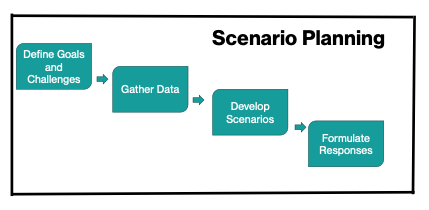
Step 1: Define Goals, Challenges and Critical Uncertainties
To start this process, decide where you are headed and develop a view of the overall landscape.
- Clarify your product and business objectives.
- Form a cross-functional team (product, marketing, finance, ops, etc.).
- Brainstorm challenges and uncertainties in your environment: PESTLE analysis may be useful here. Look at the Political, Economic, Social, Technological, Environmental and Legal environments that may impact you.
- Prioritize the uncertainties that will most impact your success. To do this you may want to develop criteria to assess each challenge against. This may help determine which are most important.
Example: A payments company aiming to lead in digital payments in two years should assess regulatory risks, customer behavior changes, and emerging technologies like blockchain and digital identity. In particular, the emerging technology area may have the biggest impact and may be hardest to forecast over the next few years.
Step 2: Gather Data
- Collect external data: economic trends, regulation, market forecasts, technology forecasts.
- Collect internal data: product metrics, customer feedback, company skills and resources.
- Use both qualitative (interviews, expert input) and quantitative (historical performance, market trends) sources.
Visual Tip: Use a mind map or infographic to link drivers (e.g., inflation, tech trends) to possible outcomes.
Step 3: Develop Scenarios
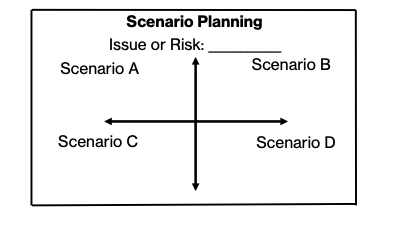
- For each critical uncertainty, outline at least three scenario narratives. For example: Optimistic, Neutral, Pessimistic.
- Create short, detailed scenarios describing possible futures and the impacts they would have on your mission. Then visualize how your organization might pivot within each scenario. With your team, discuss the opportunities and challenges inherent in each scenario. Ask for each:
- How likely is this to happen?
- What are the risks?
- What are the opportunities?
- What would we do if this happened?
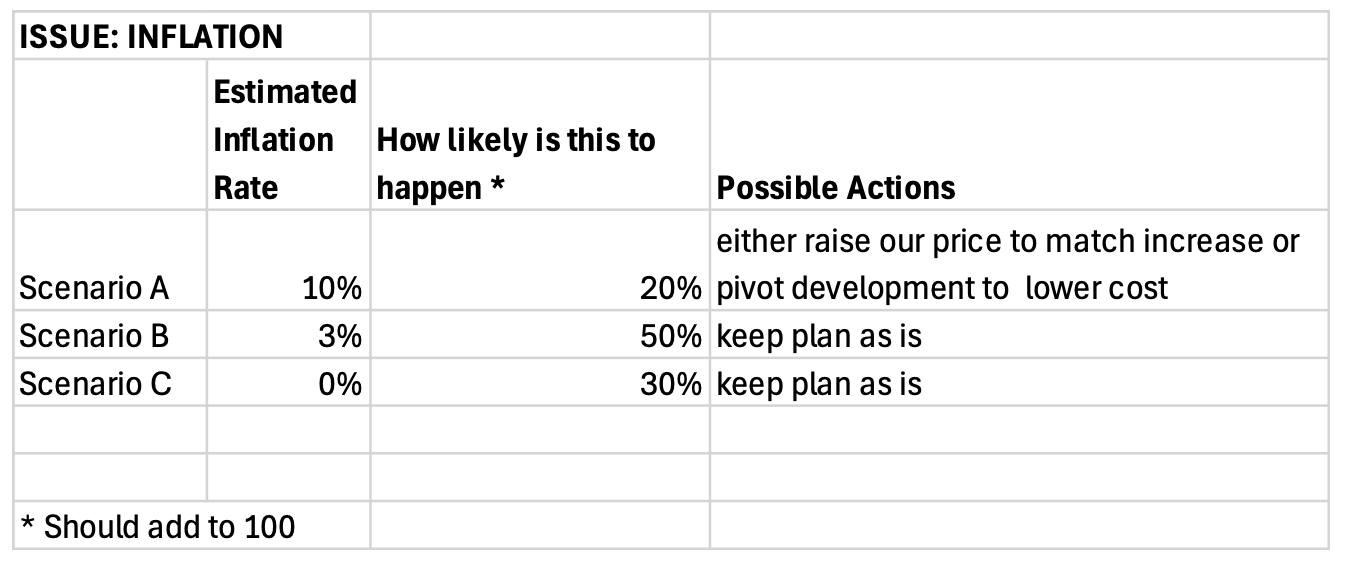
- Assign probabilities where possible. Probability-based analysis involves assigning likelihoods to different future scenarios. By using probabilities, businesses can assess risk and prioritize scenarios that are more likely to happen so they can focus on high-impact strategies.
- Estimate revenue and cost implications. You may also be able to estimate the revenue and cost impact of each scenario to see the financial effect. It may be difficult to be specific but estimates and ranges might be useful. This will also help identify where to put your emphasis.
-
Hold a team workshop to brainstorm implications and capture diverse viewpoints.
-
Example: Your biggest issue is possible inflation. You might want to spend the most time estimating the revenue and cost impact of Scenario A. As well as detailing the options if this happens.
Workshop Tip: Use tools like the Scenario Game or scenario canvas templates to engage stakeholders.
Step 4: Formulate Responses
- Develop a clear response playbook for each scenario including:
- Product features
- Go-to-market strategies
- Financial plans
- Operational tactics
- Define team roles and execution timelines.
Example: A SaaS team may prepare to launch a freemium model in a downturn but double down on premium features if demand stays high.
Leverage Artificial Intelligence (AI) in Scenario Planning
Consider using AI to help with scenario planning. This tool is useful in brainstorming ideas and determining potential alternatives. Also, generative AI has made it very easy to tap into the power of both internal and external data, analyzing trends and variables in a fraction of the time and cost it once took.
Common Pitfalls and How to Avoid Them
- Overreliance on the Past: Don’t let historical data blind you to disruptive future shifts.
- Lack of Familiarity: According to McKinsey, scenario planning may fail if a company is inexperienced doing this kind of planning. To ensure success, managers need to become familiar with scenario planning concepts and commit to being responsible for it. Scenario planning requires training. Run workshops and build this capability in your team.
- Overemphasis on Unlikely Scenarios: Spend the most time on the scenarios with high impact and moderate-to-high likelihood.
- Static Plans: Treat a scenario plan as a living document. Update regularly based on new information.
Tools and Visual Aids
About the Author
Rose Klimovich
 Rose Klimovich is Visiting Professor of Marketing and Management at Manhattan College in New York. She is also a Digital Marketing and Strategy consultant to small businesses and entrepreneurs.
Formerly, as the Vice President – Product Management and Product Marketing for Telx, Rose Klimovich created the Telx business strategy and developed the investment plan for new products and services in areas including colocation, cloud, Ethernet, and video conferencing. Rose’s team supported vertical markets including Financial Services, Media and Service Providers.
Prior to this, Rose was the Vice President of Business Strategy for AT&T, responsible for strategy development and investment decisions in new markets and technologies. Rose has more than 20 years of experience and achievement in designing, scaling and managing Internet, VPN and data businesses. Rose led AT&T to the #1 share position in VPN and to a leadership position in Internet Services.
Rose has an MBA and a BS in Math/Economics from Carnegie-Mellon University. Rose is Joint Chairperson of the Board of Directors of the Women’s Venture Fund.