Managed Instability: Product Innovation in a “Never Normal” World
Dr. Robert G. Cooper
kHUB post date: July 2026
Read time: 10 minutes
Given the complexity and chaos in the world today, most companies face uncertainty regarding their new product development (NPD) efforts [1,2]. But an understanding of where the environment is heading is critical to firms when they make NPD investment decisions. The 2008 recession taught a tough lesson: Firms that cut innovation spending deeply in response to uncertainty emerged from the downturn in weaker competitive shape than those that maintained a disciplined commitment [3].
Over the last decade, the phrase “never normal world” has moved from slogan to reality [4]. What once looked like a temporary period of disruption has hardened into a continuing pattern of geopolitical conflict, economic turbulence, technological acceleration, and supply chain fragility [5,6].
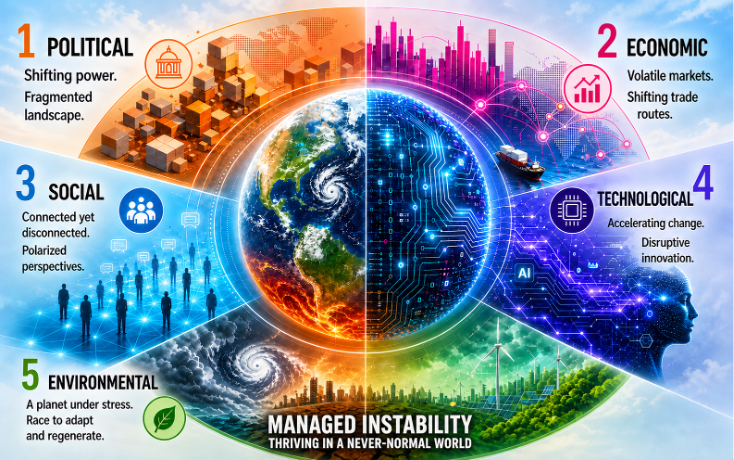
Figure 1. The next decade – five forces create a never normal world resulting in managed instability (artwork: Evan Cooper Thomas with AI Perplexity Pro).
The Era of “Managed Instability”
The implication for managers is not that the future is unknowable or that planning is futile. It is that planning must be conducted differently. The world ahead is unlikely to return to a stable and predictable normal [7]. A more plausible characterization is one of “managed instability” – a system under constant pressure, but with enough adaptive capacity to keep functioning [8,9].
We cannot predict the future, but we can prepare for it. Firms engaged in innovation must learn how to operate where disruption is recurring, assumptions expire quickly, and resilience matters almost as much as speed. Using a PESTEL lens, foresights on five major dimensions of this environment are examined – political, economic, social, technological, and environmental, as depicted in Figure 1 – and then their implications for managing NPD are derived. The results are provocative!
Political: Fragmented Power, Persistent Tension
Politically, the world is moving away from the simpler assumptions that shaped strategy in earlier decades. The era of clear U.S.-led unipolarity has given way to a more fragmented structure in which the United States, China, the European Union, India, and a number of regional powers influence different parts of the global order [10]. This is a pattern in which rivalry, selective cooperation, and regional maneuvering coexist.
For firms, that matters because geopolitics increasingly reaches into the operating core of innovation. Product teams can no longer assume stable regulatory regimes, open access to technology, or smooth global sourcing. Export controls, tariffs, sanctions, data rules, industrial subsidies, and politically motivated standards are becoming more common [11]. Countries may cooperate on climate or health while competing fiercely in AI and defense-related technologies.
Domestic politics add another layer of instability. In many countries, political systems remain intact, but they are under strain from polarization, inequality, and migration pressures [12,13]. The result is more contested policymaking and a greater tendency for government intervention during crises.
For NPD managers, the practical implication is clear: political scanning must be built into the front-end of innovation and into portfolio reviews. Projects that once looked attractive on technical and market grounds alone may now require geopolitical scrutiny as well.
Economic: Slower Growth, Tighter Resources, Smarter Resilience
Economically, the coming decade is likely to be defined by moderate but uneven growth. The world economy is unlikely to collapse, but it also seems unlikely to return to the buoyant and efficiency-driven conditions many firms once assumed. Productivity gains from automation and AI may help offset labor shortages and demographic drag in some economies, but those gains will be unevenly distributed [14].
Globalization will not reverse, but it will evolve. Supply chains are being redesigned for resilience rather than pure efficiency. That means more redundancy, more regionalization, more dual sourcing, and more willingness to carry what would once have been seen as inefficiencies [15,16,17]. Industrial policy—once out of favor—will become a central feature of economic strategy, as governments invest in semiconductors, clean energy, advanced manufacturing, and biotechnology [18].
This environment changes the economics of innovation. Resource allocation becomes harder: With governments facing debt burdens and fiscal pressure, firms may likewise find capital to be tighter than in earlier periods of cheap money [19]. This increases the need for sharper Go/No Go investment decisions, coupled with a risk mitigating, stage wise NPD process. Moreover, facing slower-growth environments, firms cannot count on market expansion alone to rescue weak projects.
Additionally, the old assumption that firms should optimize NP production mainly for speed and cost is inadequate. Cost still matters, of course, but resilience matters more! New products may need backup suppliers, alternative materials, and regional sourcing options built in. In many categories, the lowest-cost path will no longer be the wisest path.
Social: Adaptive but Strained Societies
Socially, the defining experience of the decade will be adaptation fatigue. People are adjusting continuously to hybrid work, AI-enabled workflows, digital overload, and cost-of-living concerns [20]. Trust in large institutions – governments, media, corporations – remains fragile, leading people to rely more heavily on smaller networks, local communities, and digital affinity groups [21].
Demographic trends will amplify these dynamics. Aging populations in North America, Europe, and East Asia will place pressure on healthcare systems, pensions, and labor markets, while younger populations in parts of Africa and South Asia will drive urbanization, migration, and new economic growth [22]. At the same time, traditional career paths will continue to erode, replaced by more fluid and non-linear work arrangements. Identity, both personal and professional, will become more flexible but also more uncertain [23].
For product developers, these shifts complicate market understanding. Customer needs are changing faster and often fragmenting. Segments once thought stable may split into smaller and less predictable demand clusters. At the same time, values around sustainability, privacy, affordability, convenience, and social impact differ widely across groups and geographies, and evolving sustainability and lifestyle segments create new product opportunities. Thus, social change is a double edged sword: it destabilizes existing segments but simultaneously generates new segments where focused innovations can thrive.
Traditional market research remains necessary, but not on its own. Treat market insight generation as a continuous capability rather than a project stage, using rolling ethnography, digital analysis, and rapid concept testing to track value shifts and fatigue signals.
Technological: Embedded AI
Technology is likely to be the most powerful accelerating force in the next decade, and for NPD it may be the most consequential. AI in particular is shifting from a visible tool used by specialists to being embedded across workflows and decision processes. Much as electricity eventually became part of almost everything, AI is becoming part of the infrastructure of business and innovation [24]. The point for managers is not just that AI can automate tasks; it is that AI will alter how decisions are made, how work is organized, and how rapidly product concepts can be designed, tested, refined, and launched.
This is especially important for NPD. AI can dramatically compress cycle times in idea generation, concept testing, technical problem solving, market analysis, and project review; and AI agents greatly reduce work and time in product design with digital twins, in-use simulation, and rapid product testing-and-iterations [25,26]. For example, Stage-Gate Agentic uses an agent and sub-agents to undertake an entire stage in the NPD process, “building the business case” [27]; while Microsoft’s RD-Agent autonomously executes complex, multistep R&D workflows through iterative cycles of idea generation, implementation, and refinement [28].
Some words of caution about speed, however: Like AI, Agile Development also promised speed, but it often degenerated into motion without governance [29,30]. In the absence of investment decision gates, Agile risked becoming a “perpetual go” engine, optimizing the speed of development while neglecting the more fundamental question of “should we be doing this project at all?”
Accelerated development only creates value if it remains strategically grounded — focussed on the right product and project! Moving weak concepts to market faster is not progress. The task for management is to use AI to improve both speed and decision quality.
A realistic near-term model is human-AI collaboration. Here, project teams use AI to accelerate work within stages — market studies, technical analyses, and product designs — while managers retain responsibility for interpretation, prioritization, and strategic choices at gates.
As AI capabilities advance, the bottleneck shifts from information gathering within stages to managerial judgment at gate decisions. Over time, even parts of the process — and perhaps some gates — may become increasingly automated through AI agents, as proposed in Stage-Gate Agentic [31].
Environmental: Chronic Stress and Adaptation Pressure
Environmental pressures are becoming more immediate, more visible, and more economically significant. Climate change is no longer merely a long-term concern for sustainability reports; it is shaping infrastructure reliability, insurance costs, transportation systems, water availability, and physical operating risk [32]. Now, extreme weather events, heat stress, flooding, drought, and resource volatility all affect firms more directly and more often.
At the same time, the energy transition is advancing, though not in a smooth or uniform way. Renewable energy, electrification, storage, grid modernization, and renewed attention to nuclear power are all gaining momentum. Yet fossil fuels are unlikely to disappear quickly, and many countries will operate in a hybrid energy environment for some time [33]. This combination of transition and inconsistency creates both strategic openings and operational headaches.
For NPD, environmental issues affect both opportunity and vulnerability. Many opportunities exist for firms to innovate for efficiency, circularity, emissions reduction, carbon capture, and resource productivity. On the vulnerability side, however, material availability, compliance burdens, and reputational scrutiny can all undermine product assumptions. Environmental thinking therefore needs to be deliberately built into the firm’s NP process [34].
What This Means for NPD Management
If the 1990s were about expansion and the 2010s about optimization, the 2026–2036 decade is about adaptation. That has key implications for how firms should manage innovation (see Figure 2):
1. Compress time-to-market, but intelligently. In a world where resilience and adaptability is vital, and windows of opportunity can open and close quickly, an outdated, lengthy, and bureaucratic NPD process is dangerous. But speed should be managed: The aim is not to make every project faster at any cost; it is to move quickly on the right projects.
Ways to increase speed include [35]:
a. AI to reduce work effort, both during stages and for gates.
b. Cross-functional teams with greater autonomy.
c. Repetitive “build-and-test iterations” instead of sequential builds.
d. Using some elements of Agile Development, even for physical products.
e. Removal of all work that adds no value (from “value stream mapping” and Lean Development).
f. A non-sequential NPD process—overlapping stages and tasks.
g. Better resourcing of projects the result of more focused portfolio management.
The last item requires sharper investment decisions at gates and also revisiting NPD spending overall, possibly increasing it to achieve better resourcing of projects for speed.
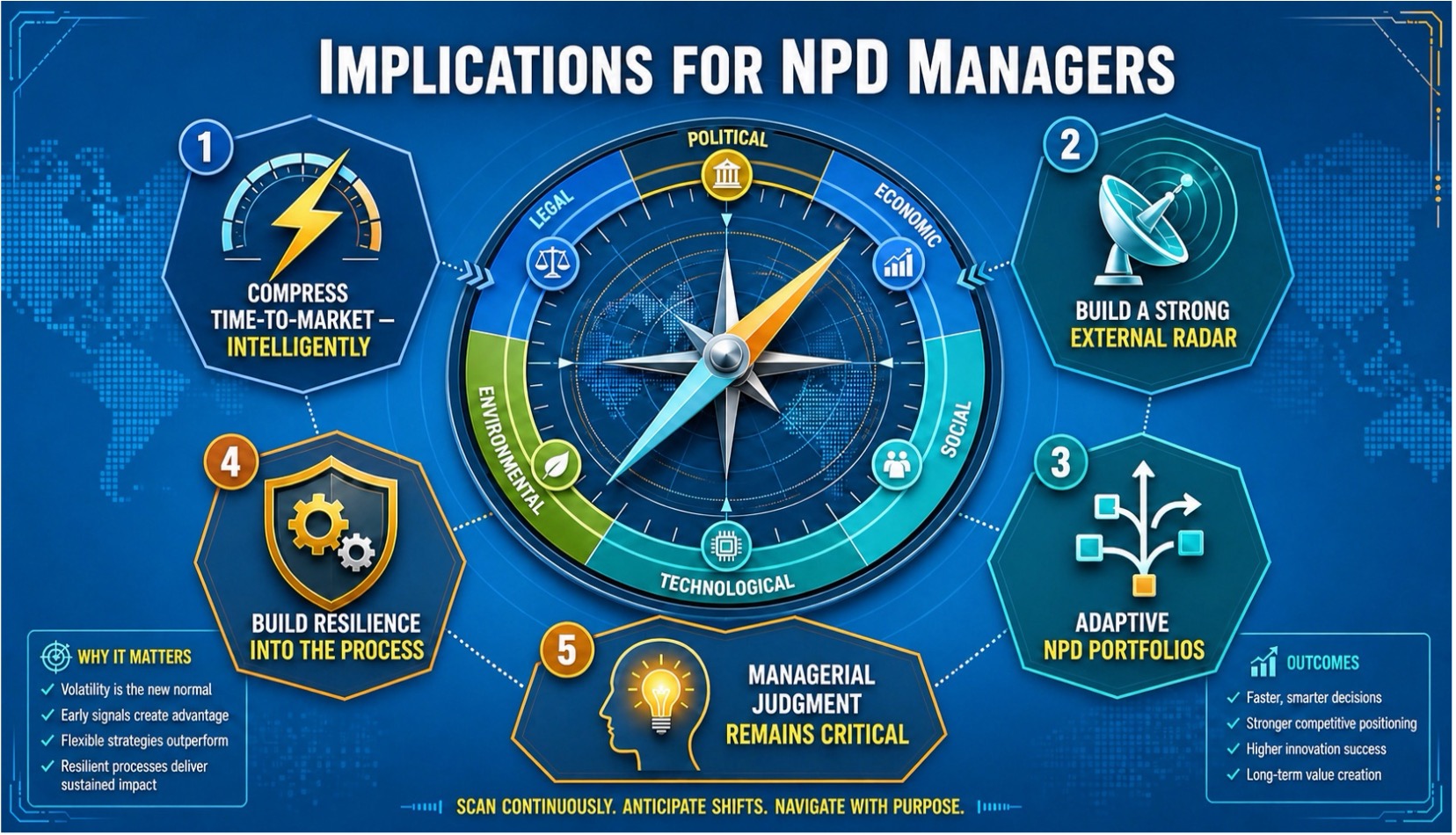
Figure 2: Five key implications for NPD management in this world of managed instability (artwork: Evan Cooper Thomas with Perplexity Pro).
2. Set up a proficient external radar system. Too many product teams and managers remain internally focused, monitoring timelines, budgets, and technical issues while failing to track the broader shifts that may reshape NPD generally or a specific project’s prospects.
In an unstable world, environmental scanning is not an optional strategic exercise carried out annually; it must become continuous. Firms must monitor signals across the political, economic, social, technological, environmental, and legal environments and alert project teams and NPD managers.
3. NP portfolios must become more adaptive. Traditional product roadmaps – the map of projects to be done and their timing – assume environmental stability. But now, project portfolios must be dynamic and reviewed regularly. Treat the new product portfolio less as a fixed plan and more as a managed set of investment options that can be activated, accelerated, or terminated, as conditions change.
4. Resilience must be built into the NPD process. This means risk registers, but more:
a. modular product architectures,
b. repetitive concept and early-prototype tests with users,
c. backup technical paths and sources-of-supply, and
d. explicit attention at gates to project vulnerability, all designed for continuity under strain.
5. Managerial judgment becomes even more important. In turbulent settings, much more data will be available, but clarity does not increase. AI tools can improve analysis and create effective NP dashboards. But they do not remove the need for strategic interpretation: Managers still must decide which risks are tolerable, which opportunities are most attractive yet leverage the firm’s capabilities, and when to commit or hold back [36].
The overall trajectory of the world is neither decline and collapse, nor smooth progress and a return to historic growth. It is a decade of continuous adjustment: managed instability. Success depends on flexibility, resilience, and the ability to operate effectively amid uncertainty.
ABOUT THE AUTHOR – Our keynote speaker at PDMA’s Ignite Innovation Summit, October 8-9, 2026
Dr. Robert Cooper, Professor Emeritus, McMaster University, Canada ISBM Distinguished Research Fellow at Penn State University
Dr. Robert G. Cooper is a Crawford Fellow of the Product Development and Management Association (PDMA) and creator of the popular Stage-Gate® process. He was ranked #1 Scholar in “Product Innovation” for 2025 globally, and #3 in Marketing by ScholarGPS.com. Bob has published 12 books—including the “bible for NPD”, Winning at New Products—and more than 170 articles on the management of new products, notably 17 articles on “AI in NPD”. He has won the IRI’s (Innovation Research Interchange) prestigious Maurice Holland Award three times for “best article of the year”.
Bob Cooper is co-founder and former CEO of Stage Gate International. He is now ISBM Distinguished Research Fellow at Pennsylvania State University’s Smeal College of Business Administration; Professor Emeritus at McMaster University’s DeGroote School of Business (Canada); and Honorary Advisor, Snyder Innovation Management Center, Syracuse University. Bob has helped hundreds of firms over the years implement best practices in product innovation, including many Fortune 500 firms. Cooper holds Bachelor and Master’s degrees in chemical engineering from McGill University in Canada; and a PhD in Business and an MBA from Western University, Canada. He lives in Toronto and Sarasota FL.
Website: www.bobcooper.ca
Contact: bobcooper675@gmail.com
References
[1] World Economic Forum, “Global Risks Report 2026: Geopolitical and Economic Risks Rise in a New Age of Competition,” WEF. (Jan. 14, 2026). Link: https://www.weforum.org/publications/global-risks-report-2026/
[2] OECD, “Global Scenarios 2035: Exploring Implications for the Future of Global Collaboration and the OECD,” OECD Publishing, Paris. (2021). Link: https://doi.org/10.1787/df7ebc33-en.
[3] Ranjay Gulati, Nitin Nohria, and Franz Wohlgezogen, “Roaring Out of Recession.” Harvard Business Review. (March 2010). https://hbr.org/2010/03/roaring-out-of-recession
[4] Casey Gale, “Peter Hinssen Wants You to Embrace the ‘Never Normal’,” PCMA Convene. (Dec 23, 2020). Link: https://www.pcma.org/peter-hinssen-embrace-never-normal/
[5] Peter Fisk, “Megatrends 2035: The Dramatic Forces Shaking Up Every Market,” personal website/report. (July 31, 2025). Link: https://www.peterfisk.com/2025/07/megatrends2035/
[6] Evcurve Futurist, “The Disruption Decade: 2025–2035 and the New World Order,” Evcurve Futurist, (Sept. 23, 2025). Link: https://evcurvefuturist.com/2025/09/the-disruption-decade-2025-2035-and-the-new-world-order/
[7] Anita Sommer, “Mission-driven Innovation: How to Lead Technology in a Complex World,” Grammar Factory Publishing. Chapter 2, Forthcoming, (2026).
[8] OECD, “Resilience Strategies and Approaches to Contain Systemic Threats,” OECD New Approaches to Economic Challenges initiative, Organization for Economic Cooperation and Development, (Sept. 9, 2019). Link: https://www.oecd.org/en/about/programmes/naec.html
[9] RANE. 2025. “RANE’s Decade Forecast 2025–2035: Five Critical Factors That Will Shape the Coming Decade,” RANE Network (Risk Assistance Network + Exchange), (Feb. 24, 2025). Link: https://www.ranenetwork.com/blog/ranes-decade-forecast-2025-2035-five-critical-factors-that-will-shape-the-coming-decade
[10] See endnotes [2] and [9].
[11] See endnote [2].
[12] See endnotes [1] and [2].
[13] UNCTAD, “Trade and Development Foresights 2025: Under pressure – uncertainty reshapes global economic prospects,” United Nations Conference on Trade and Development (2025). Link: Trade and Development Foresights 2025: Under pressure – uncertainty reshapes global economic prospects | UN Trade and Development (UNCTAD)
[14] See endnotes [1], [2], and [13].
[15] OECD, “OECD Supply Chain Resilient Review,” OECD, (June 2, 2025). Link: https://www.oecd.org/en/publications/oecd-supply-chain-resilience-review_94e3a8ea-en.html
[16] John Lorinskas and Tatyanna Dadabbo, “From ’Just-in-Time’ to ‘Just-in-Case’ to… ‘Just Next Door?’” Martec, (2026). Link: How Supply Chain Diversification Is Evolving into Regional Resilience - Martec
[17] Knut Alicke, Tacy Foster, Katharina Hauck, and Vera Trautwein, “Tech and Regionalization Bolster Supply Chains, But Complacency Looms.” McKinsey & Company, (2023). Link: Tech and regionalization bolster supply chains, but complacency looms | McKinsey
[18] See endnotes [2] and [13].
[19] IMF (international Monetary Fund), “Fiscal Policy in the Great Election Year: Expanding Frontiers – Fiscal Policies for Innovation and Technology Diffusion,” Fiscal Monitor, (April 2024), Chapter 2. International Monetary Fund. Link: elibrary.imfyoutube
[20] See endnotes [1] and [2].
[21] Jeffrey M. Jones, “Confidence in U.S. Institutions Down; Average at New Low,” Gallup, (July 4, 2022). Link: Confidence in U.S. Institutions Down; Average at New Low
[22] World Bank Gorup, “Demographic Trends and Urbanization”, World Bank Group (May 19, 2021). Link: Demographic Trends and Urbanization
[23] Jonathan H. Westover, “Rethinking the Traditional Career Path: Embracing Flexibility and Growth in the Modern Workplace,“ Human Capital Innovations, (March 9, 2024). Link: Rethinking the Traditional Career Path: Embracing Flexibility and Growth in the Modern Workplace
[24] See endnotes [1], [2], and [5].
[25] Cooper, Robert G., “The Artificial Intelligence Revolution in New-Product Development," IEEE Engineering Management Review (52) 1, (Feb. 2024): 195–211. doi: 10.1109/EMR.2023.3336834. Link: The Artificial Intelligence Revolution in New-Product Development | IEEE Journals & Magazine | IEEE Xplore
[26] Cooper, Robert G., “AI Powered Stage Gate: Supercharging Your Idea to Launch Process”, PDMA kHUB, (April 30, 2026). Link: AI Powered Stage Gate: Supercharging Your Idea to Launch Process - Knowledge Hub 2.0
[27] Robert G. Cooper, “Stage-Gate Agentic: The Coming Revolution in the New Product Process,” PDMA kHUB 2.0, (December 2025). Link: https://community.pdma.org/knowledgehub/bok/product-innovation-process/stage-gate-agentic-the-coming-revolution-in-the-new-product-process
[28]. S. Hassan, “Microsoft AI Releases RD-Agent: An AI-Driven Tool for Performing R&D With LLM-Based Agents,” MarkTechPost, (March 22, 2025). Microsoft AI Releases RD-Agent: An AI-Driven Tool for Performing R&D with LLM-based Agents - MarkTechPost
[29] Colin Bryar and Bill Carr, “Have We Taken Agile Too Far?” Harvard Business Review (April 9, 2021). Link: Have We Taken Agile Too Far?
[30] Kareem Abdelsadek and Sam Martin, “Managing an Agile program? Consider an AMO,” Deloitte Insight, Government and Public Services, (Sept. 7, 2017). Link: Agile management office | Deloitte Insights
[31] R.G Cooper and Alex M. Brem, “Stage-Gate Agentic: Reinventing New Product Development with Artificial Intelligence,” in process with IEEE Transactions on Engineering Management, (2026). See also endnote [24].
[32] See endnotes [1], [2], [8], and [13].
[33] See endnotes [1], [2], and [9].
[34] Robert G. Cooper, “Eco-Stage-Gate: Building Sustainability into Product Innovation,” IEEE Engineering Management Review (53) 5, (Oct. 2025): 25–32. Link: https://doi.org/10.1109/EMR.2024.3493492. https://ieeexplore.ieee.org/document/10572277
[35] Robert G. Cooper, "The 5-th Generation Stage-Gate Idea-to-Launch Process," in IEEE Engineering Management Review, . 50, no. 4, pp. 43-55, 1 Fourth quarter, Dec. 2022, doi: 10.1109/EMR.2022.3222937.
[36] See endnote [31].