New Product Governance in a Time-Compressed World
Dr Robert Cooper & Dr. Xinjin Zhao
kHub Post Date: August 5, 2026
Read Time: 13 Minutes
Today’s product leaders face a new problem. Our innovation environment has changed dramatically: markets move faster, customers provide immediate feedback, AI compresses development cycles, and competitors learn continuously. Yet many companies still govern innovation with decision systems designed for a slower world. The challenge is no longer making perfect investment decisions—it is maximizing learning velocity.
Stage-Gate® has helped thousands of firms build better new products for over forty years by providing a disciplined approach for new product development (NPD). The challenge today is no longer whether to use Stage-Gate, but how to redesign it for continuous learning: adapting its governance to an environment where uncertainty is high, feedback is fast, and the cost of learning has fallen. Witness how AI now enables firms to prototype, simulate, test and learn dramatically faster, in days rather than months!
Facing this new environment, the real question is: how do we redesign decision gates so they enable learning?
Gates should maximize learning velocity rather than optimize investment decisions. That’s the next evolution of Stage-Gate governance.
 Figure 1: Why traditional gates no longer fit today’s environment—moving from the original notion of gates to gates that enable learning velocity.
Stage-Gate Was Revolutionary
Stage-Gate emerged in the 1980s to address problems faced in product innovation [1]. Development was expensive, markets were slower-moving, and many firms struggled with weak commercial discipline. The typical Innovation challenges of that era were the lack of market information, Go/Kill decisions without clear criteria and accountability, and too many projects competing for limited resources.
Stage-Gate was based on the key success factors in product innovation identified in studies conducted in the 70s and 80s, and also by observing very successful project teams. Gates were created which addressed the problems above in a number of ways:
- Risk management through incremental commitment—increasing commitments stage-by-stage, decisions made at gates.
- Cross‑functional alignment—bringing marketing, R&D, operations, and finance leaders together at gates.
- Objective Go/Kill criteria to improve decision quality and consistency.
- Portfolio management and project prioritization.
- Governance and accountability, with formal gate meetings and designated gatekeepers [2].
Concurrently, stages were defined that prescribed critical tasks—market assessments, product tests, production trials—that generated the information needed for sound Go/Kill decisions at each gate. Notably, Stage-Gate requires better pre-development homework and information to better define the product and to create a robust business case.
|
Five changes NP managers should make tomorrow
- Default to Conditional Go.
- Replace approval meetings with learning reviews.
- Measure learning velocity.
- Use AI to accelerate experiments.
- Monitor projects continuously via dashboards.
|
In many organizations, Stage-Gate processes were used beyond new product development (NPD) but for projects undertaken over time that entail investment with significant uncertainties and risk. Versions of Stage-Gate exist for capital investments, fundamental research projects, and even AI adoption-and-deployment projects.
How Bureaucracy Crept In
Stage-Gate was never intended to create bureaucracy. Its purpose was to improve decision quality through better information, stronger governance, and more effective resource allocation. When used as intended, it balances discipline with learning, helping teams make better decisions while moving projects forward. The problem was not with Stage-Gate’s original intent, but with how it was often implemented. In many firms, gates became ends in themselves: Project teams treated “getting through the gate” as the definition of winning [3]. They invested disproportionate effort in preparing elaborate slide decks and rehearsed presentations for gate meetings, often at the expense of actual customer learning or technical progress. The overemphasis on “passing the gate” can lead organizations to miss opportunities to identify overall constraints early [4].
This gate‑centric behavior created several pathologies:
- The perceived goal became “project approval” rather than “success in the marketplace.”
- Preparation for gate meetings consumed time and energy without adding value.
- Teams optimized for passing gates rather than for building and testing actual solutions.
The result is innovation bureaucracy: Gates that were supposed to improve decision quality became rituals that slowed momentum and distracted teams. Although the actual stage gate process has built-in flexibilities, teams often do not feel empowered to take advantage of those “exceptions”.
Limitations to Gate Decisions
To help managers make gate decisions—”should we invest in this project?”, a Go/Kill decision—gate structures were improved, and tools were developed. These included probability-adjusted financial models, the project’s productivity index, and multi-factor scorecards [5]. Additionally, better information was delivered to each gate, the result of better execution of prescribed tasks within stages.
History and evidence, however, reveal we may be bumping up against the practical limits of improving these Go/Kill decisions. Nobel prize-winner Daniel Kahneman and his work on human decision-making and judgment raise flags. He is a co-developer of the field of “behavioral economics”, which argues that markets (and humans) are not rational decision-makers at all [6]. His work, showcased in Thinking Fast and Slow, defines System 1 and System 2 thinking—intuitive versus more thoughtful decision-making—and shows that humans are very prone to biases and errors, especially when making decisions under uncertainty [7].
Data from PDMA and others suggest that Kahneman’s theory appears to capture NPD decisions. Despite all the effort, new product success rates remain low: only 30 percent of projects approved for development actually succeed in the market, worse than the toss of a coin! [8]. All this gating rigor has not delivered consistently better decisions and results!
Because human judgment is inherently imperfect under uncertainty, organizations should rely less on predicting correctly upfront. The emphasis should be on learning rapidly after decisions are made—armed with the new information, then adjust or pivot.
China’s Innovation Process: Solving a Different Problem
Many Chinese firms use Stage-Gate or very similar processes, but with a different emphasis [9]. Rather than trying to ration scarce capital among too many ideas, Chinese firms typically faced explosive market growth, large‑scale deployment opportunities, and manufacturing ecosystems operating at unprecedented speed [10].
Chinese innovation systems thus evolved under a very different set of constraints and opportunities. As a result, their NPD processes feature practices that compress activities:
- Parallel engineering, with overlapping technical and commercial workstreams.
- Integrated supply chains that prepare manufacturing in tandem with development.
- Simultaneous manufacturing and product refinement.
- Earlier, more frequent customer involvement.
- Overlapping decision cycles rather than rigid stage separations [11].
These practices underlie what is depicted as “China Speed”, but are not unique to China; they are also part of 5th Generation Stage-Gate in the West [12]. Note that the term “time compression” is more accurate than “speed” to describe the Chinese NPD approach [13]. The system does not necessarily skip important steps nor do people work faster and harder; rather, it reveals and surfaces system constraints early and forces management to make decisions without complete information early through overlapping learning, design, and deployment.
Two Systems, Two Strategic Biases
Every innovation process embeds a bias. Early Stage-Gate systems in the U.S. deliberately biased firms toward:
- avoiding false positives—preventing bad projects from consuming scarce resources,
- protecting capital through rigorous pre‑commitment analysis, and
- reducing uncertainty and risk before significant investment and scale‑up.
Dynamic industries, however, require a different core question: The gate decision is less about “which ideas deserve investment?” and more about “how do we turn promising ideas into market‑leading products before competitors do?” Competitive advantage comes from shortening the “learning from deployment” cycle rather than perfecting the initial plan. In China, electric vehicles, software platforms, biotech therapies, and industrial technologies are all examples where learning from doing applies.
In such industries, a deployment‑oriented model, as used in China, biases firms toward:
- avoiding false negatives—ensuring promising opportunities are not prematurely killed,
- maximizing learning opportunities through market exposure, and
- reducing uncertainty primarily through iterations and feedback.
Thus, in this system, the main uncertainty is not whether to do the project, but how to move forward and move fast. Deployment with feedback—”build and test” iterations—becomes the primary mechanism for learning. Thus, markets themselves become “customer laboratories” and are part of the development process, and deployment becomes a learning mechanism rather than just the final execution step.
Large petrochemical or refining investment projects in China, for example, tend to feature a shorter duration for the first major turnaround—a much faster iteration. This occurs in order to “fix any shortcomings” in the original design, or make changes to adjust to the quickly changing new markets and market dynamics.
From Making Investment Decisions to Learning Velocity
A fast-moving external environment coupled with managers’ decision-making limitations suggests that chasing “perfect Go/Kill decisions” may be a fool’s errand. Instead, gates should help get projects moving, facilitate learning, and foster iterating quickly—this means making decisions that are “good enough” to proceed, coupled with mechanisms for rapid feedback and course correction. In short, make a Conditional Go decision but build in a series of feedback loops—market demos and technical tests—to validate the Go decision and at the same time move the project along.
For Stage-Gate, this implies a fundamental shift:
- Gates should focus less on making the right Go/Kill investment decisions.
- Instead, the question for gatekeepers becomes “is there a good reason not to move ahead?” Otherwise, their decision is Conditional Go—move forward.
- Gate discussions then devote more time to “what do we do next to resolve risks?”—the next experiments and feedback loops, customer tests, design iterations—than to debating whether the team may proceed.
In this reframed gate logic, decisions that get an adequate product or MVP in front of customers and into lab tests quickly are more valuable than delayed but “perfect” investment decisions, as shown in Figure 2. The goal shifts from making perfect investment decisions to learning velocity.
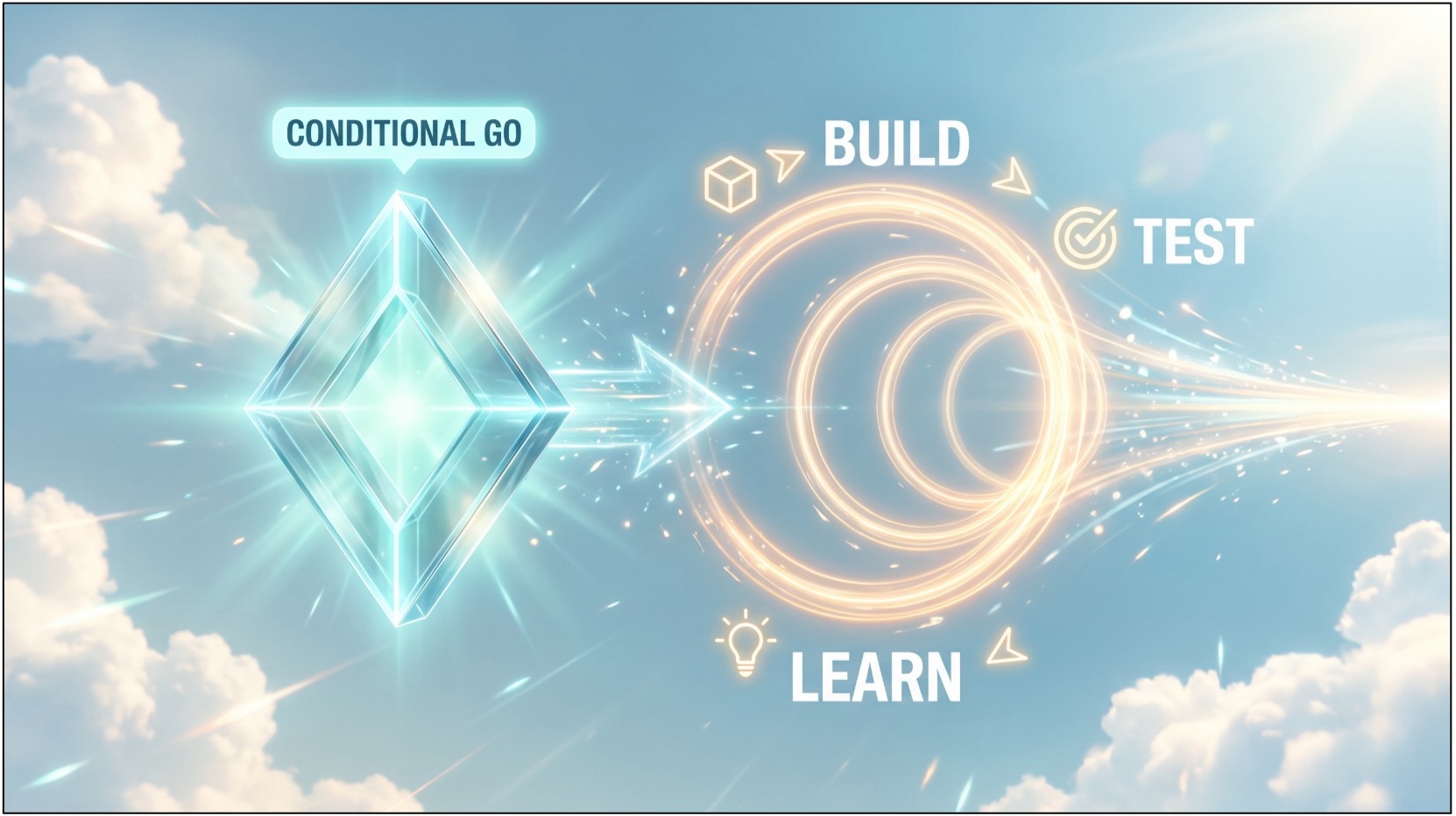 Figure 2: How modern gates work—focusing less on Go/Kill decisions and more on “moving forward”, conditional Go decisions followed by rapid iteration learning loops to validate the decisions.
AI tools facilitate the rapid iterations and feedback loops needed for learning velocity: For example, for a physical product, AI can create successive virtual prototypes, each one closer to the final product, then a 3-D printed product, and assist in creating an MVP. Each version can be built quickly and can be tested technologically for performance and reliability, and also with the customer for their reaction and purchase intent, as well as for in-use testing.
Dynamic Gates and Real-Time Governance
One criticism of this iterative learning approach occurs in Agile development: Agile fosters “perpetual-go machine”, according to some articles [14]. Once a project is approved, it advances sprint by sprint without rigorous reconsideration; the project often proceeds even when new information surfaces that the project is less attractive than originally believed.
The risk is that teams can wander in circles or continue to push weak concepts forward simply because the process keeps moving. Some firms have found that more management involvement is required: “…senior management expressed concerns that project teams, so heavily focused on the next 2–3-week sprint, had lost sight of the ultimate goal, thus requiring senior management intervention” [15].
To avoid the perpetual-go machine, dynamic portfolio management with real-time gates is one solution—governance mechanisms that operate continuously, informed by real‑time data, rather than static meetings scheduled on a calendar [16]. A dynamic gate relies on a limited set of metrics that can be made accessible via a dashboard to gatekeepers, such as:
- Go/kill recommendation.
- On‑time performance.
- Economic value to the company (e.g., updated NPV, ROI, or Expected Commercial Value).
- Likelihood of success.
- Project Productivity Index (the added value for each additional dollar spent on the project).
With these metrics visible day‑by‑day, gatekeepers can convene gate reviews when signals indicate negative information or heightened risk, not only when the calendar dictates (see Figure 3).
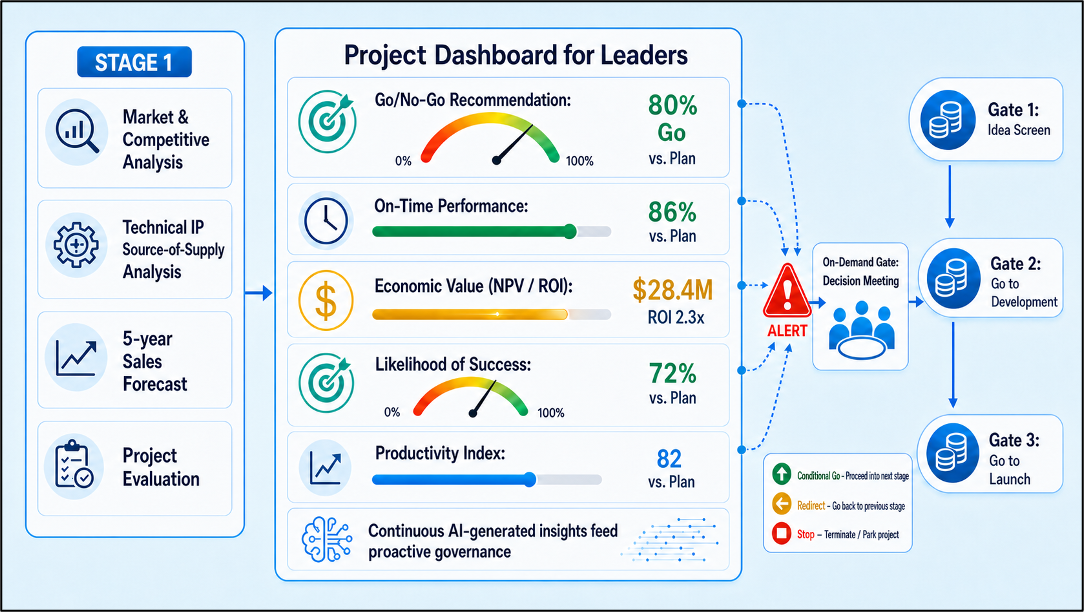 Figure 3: How executives manage continuously instead of periodically—a dashboard informs leaders about the progress, health and prospects of the new-product project in real-time.
Dashboards that display real-time metrics are currently available today, but for other business functions (Sales, Finance, Supply-chain, and Marketing); we could find none that provide continuous decision support for NPD (Gartner, 2026). This is an emerging capability.
Redefining Leadership in Compressed Innovation
Compressed innovation systems place more responsibility on leaders. They operate with greater ambiguity, shorter decision windows, and continuous adaptation. Process remains important, but judgment becomes even more critical. The ideal is leadership that shifts from enforcing compliance to orchestrating learning: spending less time approving and more time framing hypotheses, supporting experiments, allocating resources and removing bottlenecks, and interpreting market signals.
Hope is not a strategy, however. Evidence from decades of research into NPD suggests that many leaders have often not embraced the best practices needed to improve NPD performance. Despite clear prescriptions about why new products fail and how to reduce failure rates, PDMA studies show limited improvement over time. Human biases, organizational inertia, and short‑term pressures often override good intentions [17].
This is why structural changes to gates and governance matter. We cannot simply exhort leaders to “be more adaptive” and “use better judgment”. Instead, we must redesign the operating system so that:
- Gates default to moving ahead with controlled experiments unless strong reasons exist to halt.
- Gate discussions focus on winning in the marketplace: which customers, which value proposition, which next tests?
- Project teams are empowered as autonomous units to make many design, feature, and pricing decisions within clear strategic guardrails.
Leadership then becomes less about micro‑evaluating every project decision and more about designing systems where learning happens quickly, safely, and at scale. Gates should maximize learning velocity rather than just make investment decisions.
The Future: Combining Discipline and Compression
The next frontier is helping organizations learn faster. In increasingly dynamic markets, advantage will come not from abandoning discipline, but from compressing the cycle.
The future belongs to firms that can:
- preserve the discipline of Stage-Gate for NPD, including gates, but with the emphasis on moving ahead —more like “conditional Go decisions”,
- embrace compression where rapid iteration and deployment can resolve uncertainty,
- implement dynamic gates that use real‑time metrics to guide continuous decisions, and
- reorient gate conversations to address “how we win in the marketplace” and “what we do next,” rather than around elaborate approval rituals.
By combining the best of Stage-Gate with the learning velocity of compressed innovation, firms can build innovation systems fit for the fast, uncertain markets that now define much of the world. The companies that dominate the next decade will not necessarily have the smartest engineers or the largest R&D budgets. They will be the organizations that learn faster than everyone else. The role of Stage-Gate is no longer just to mitigate risk—it is to accelerate learning. In tomorrow’s innovation systems, the fastest learner—not the best planner—wins:
“According as circumstances are favorable, one should modify one’s plans.”
— Sun Tzu, The Art of War, trans. Lionel Giles (1910)
“Plans are worthless, but planning is everything.”
— Dwight D. Eisenhower
About the Authors
Dr. Robert Cooper, Professor Emeritus, McMaster University, Canada; ISBM Distinguished Research Fellow at Penn State University
Dr. Robert G. Cooper is Crawford Fellow of the Product Development and Management Association (PDMA) and will be our keynote speaker at PDMA’s Ignite Innovation Summit, October 8-9, 2026. Bob is the creator of the popular Stage-Gate® process, and has published 12 books and more than 170 articles on the management of new products.
Bob Cooper is co-founder and former CEO of Stage Gate International. He is now ISBM Distinguished Research Fellow at Pennsylvania State University’s Smeal College of Business Administration; Professor Emeritus at McMaster University’s DeGroote School of Business (Canada); and Honorary Advisor, Snyder Innovation Management Center, Syracuse University. Bob has helped hundreds of firms over the years implement best practices in product innovation, including many Fortune 500 firms. Cooper holds Bachelor and Master’s degrees in chemical engineering from McGill University in Canada; and a PhD in Business and an MBA from Western University, Canada.
Dr. Xinjin Zhao, held global leadership roles at ExxonMobil in Technology Development, Technology Licensing, and Investment
Xinjin Zhao is a retired global business executive with more than 30 years of leadership experience in the energy and chemical industries. During his career at ExxonMobil, he held global leadership roles spanning technology development, technology sales and licensing, and investment, including leading the development of the company’s largest investment in China, a $10 billion petrochemical complex.
With a Doctor of Science from MIT and an MBA from the Wharton School, he writes on business strategy, innovation, and leadership in an increasingly complex global environment. His weekly LinkedIn newsletter on leadership and decision-making reaches over 300,000 subscribers worldwide, serving as a global platform to engage senior executives, emerging professionals, and lifelong learners. He is also the author of the best- selling book “The Odyssey of Self-Discovery: On Becoming A Leader”, published in both the United States and China.
References
[1] Robert G. Cooper, “Stage-Gate Idea to Launch System,” Wiley International Encyclopedia of Marketing: Product Innovation & Management (Volume 5), B.L. Bayus (ed.), West Sussex, UK: Wiley: (Dec. 15, 2010): Part 5. https://doi.org/10.1002/9781444316568.wiem05014
[2] Robert G. Cooper, “Stage-Gate: The “Official” Version,” PDMA kHUB (Feb. 3, 2026). https://community.pdma.org/knowledgehub/blogs/robert-cooper/2026/02/03/stage-gate-the-official-2026-version
[3] Michael Mills, “Implementing a Stage-Gate® Process at Procter & Gamble,” Association for Manufacturing Excellence International Conference, Competing on the Global Stage, Cincinnati, Ohio, (Oct. 2004).
[4] Xinjin Zhao, “Being a Slave to Your Business Process will Destroy You,” Leadership and Decision Making (2018). https://www.linkedin.com/pulse/being-slave-your-business-process-destroy-you-xinjin-zhao/
[5] Rick Mitchell, Rob Phaal, Nikoletta Athanassopoulou, Clare Farrukh, and Christian Rassmussen, “How to Build a Customized Scoring Tool to Evaluate and Select Early-Stage Projects,” Research-Technology Management, 65 (3): (2022): 27–38. https://www.tandfonline.com/doi/full/10.1080/08956308.2022.2026185
[6] Daniel Kahneman, “Maps of Unbounded Rationality: A Perspective on Intuitive Judgement and Choice,” Nobel Prize Lecture, (Dec. 8, 2002). https://www.nobelprize.org/uploads/2018/06/kahnemann-lecture.pdf .
[7] Daniel Kahneman, Thinking, Fast and Slow. Macmillan, (2011). ISBN 978-1-4299-6935-2.
[8] Mette P. Knudsen, Max von Pedowitz, Abbie Griffin, and Gloria Barczak, “Best Practices in New Product Development and Innovation: Results from PDMA’s 2021 Global Survey,” Journal of Product Innovation Management, 40: (2023): 257–275. https://doi: 10.1111/jpim.12663
[9] Matthew J. Robson, Fu-Mei Chuang, Robert E. Morgan, Nilay Bıçakcıoğlu-Peynirci, C. Anthony Di Benedetto, “New Product Development Process Execution, Integration Mechanisms, Capabilities and Outcomes: Evidence from Chinese High-Technology Ventures,” British Journal of Management, 34(4), (2022): 2036–2056. https://doi.org/10.1111/1467-8551.12686
[10] Xinjin Zhao, “Beyond Speed: Understanding the System Behind China’s Innovation,” Leadership and Decision Making, (2026). https://www.linkedin.com/pulse/beyond-speed-understanding-system-behind-chinas-innovation-zhao-n9mrc/
[11] Xinjin Zhao. Descriptions of Chinese NPD practices from author’s direct observations and personal communications with other practitioners.
[12] Robert G. Cooper, “The 5-th Generation Stage-Gate Idea-to-Launch Process,” IEEE Engineering Management Review, 50 (4): (Dec. 2022): 43–55. https://doi.org/10.1109/EMR.2022.3222937
[13] Robert G. Cooper, “‘China Speed’: Accelerated Product Development the Chinese Way,” KHUB PDMA Knowledge Hub. (Jan. 20, 2026). https://community.pdma.org/knowledgehub/blogs/robert-cooper/2026/01/16/china-speed-accelerated-product-development-the-ch
[14] Colin Bryar and Bill Carr “Have We Taken Agile Too Far?”, Harvard Business Review, (April 9, 2021). Have We Taken Agile Too Far? | Harvard Business Impact Education
[15] Robert G. Cooper. “Agile-Stage-Gate Hybrids: The Next Stage for Product Development,” Research-Technology Management, 59 (1): (Jan. 2016): 1–9. https://doi.org/10.1080/08956308.2016.1117317
[16] Robert G. Cooper and Anita F. Sommer, “Dynamic Portfolio Management for New Product Development,” Research-Technology Management, 66 (3): (2023): 19–31, https://doi.org/10.1080/08956308.2023.2183004
[17] See PDMA best practices study, endnote [8]; also: The PDMA Handbook of Innovation and New Product Development, 4th ed., edited by Ludwig Bstieler and. and Charles H. Noble, Hoboken, NJ: John Wiley & Sons Inc: (2023): Chapter 1. ISBN: 978-1-119-89021-8. The PDMA Handbook of Innovation and New Product Development: Bstieler, Ludwig, Noble, Charles H.: 9781119890218: Amazon.com: Books