Artificial intelligence is transforming how products are designed, developed, and improved. Companies now have access to unprecedented computing power, advanced AI models, and global engineering teams capable of building remarkable technologies at incredible speed. Yet despite these advances, one fundamental element of innovation has remained unchanged: someone must first recognize a problem worth solving.
That is where independent inventors continue to matter.
Observation: The True Starting Point
Innovation rarely begins with technology alone. It begins with observation. Before artificial intelligence writes code, before engineers build prototypes, and before companies allocate research budgets, someone has to notice an unmet need and imagine a better way forward.
Large organizations excel at refining products, scaling successful ideas, and investing in long-term research. Independent inventors often contribute in a different way. They are not limited by existing product roadmaps, quarterly priorities, or organizational structures. Their freedom allows them to ask simple but important questions:
- Why does this problem still exist?
- Why hasn’t anyone solved it differently?
- Could there be a better approach?
This perspective has historically contributed to meaningful innovation across industries. While not every independent idea becomes a commercial success, independent inventors expand the range of possibilities by exploring solutions that may never emerge through conventional development processes.
Human Curiosity vs. Artificial Intelligence
The rise of artificial intelligence has not diminished this role. In many ways, it has made it even more important.
AI is an extraordinary tool for accelerating research, generating designs, analyzing information, and supporting engineering teams. However, AI does not independently determine which real-world problems deserve attention. It does not naturally experience the frustrations of patients navigating healthcare systems, customers searching for products, travelers facing transportation challenges, or employees working through inefficient processes.
People do.
Human observation remains the starting point of meaningful innovation. AI strengthens the process, but it does not replace the curiosity that begins it.
The Unsolicited Submission Dilemma
Today, many large companies recognize the value of external innovation and provide channels for independent submissions. At the same time, these companies often adopt unsolicited idea policies stating that submitted materials will not be treated as confidential. Such policies serve legitimate legal purposes by reducing the risk of intellectual property disputes when companies are developing similar technologies internally.
Yet these policies can also create an unintended consequence.
Many independent inventors spend months—or even years—developing early-stage concepts. When they are asked to disclose those ideas without confidentiality protections, some choose not to submit them at all.
This does not necessarily mean companies are rejecting valuable innovations. Instead, it raises an important question: How many potentially useful ideas never reach evaluation because they are never shared in the first place?
Building Better Pathways
This question deserves thoughtful discussion, not criticism.
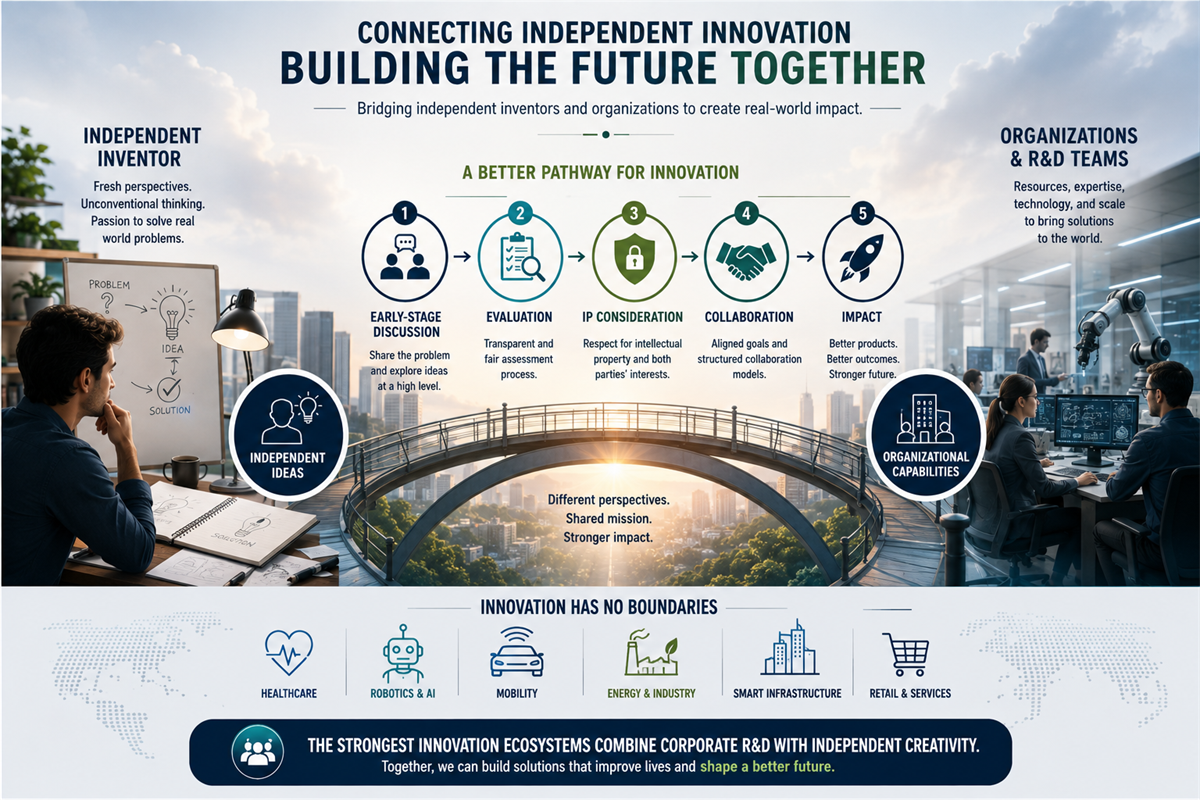
Companies have valid legal responsibilities. Independent inventors have understandable concerns about protecting their work. Rather than viewing these interests as conflicting, there is an opportunity to design better pathways that serve both.
Organizations could explore structured programs specifically designed for independent innovators, including early-stage discussions before technical disclosure, transparent evaluation processes, and collaboration models that respect both intellectual property considerations and the value of external creativity.
Such approaches would not eliminate legal complexities, but they could encourage more constructive engagement between companies and independent inventors.
The Future of Innovation Ecosystems
Innovation has never belonged exclusively to large corporations, universities, or government laboratories. Throughout history, transformative ideas have emerged from individuals who simply observed everyday problems and imagined practical solutions.
The AI era does not change that reality. If anything, it reinforces it.
Artificial intelligence will continue to reshape industries, automate processes, and accelerate product development. But technology alone cannot decide what should be built next. The future will still depend on people who recognize overlooked problems, ask difficult questions, and challenge conventional thinking.
Independent inventors remain part of that future—not because they compete with large organizations, but because they contribute something different.
The strongest innovation ecosystems will not be those that choose between corporate research and independent creativity. They will be the ones that successfully bring both together.
How is your organization currently balancing internal AI R&D with external independent innovation? What practices have worked best for you? Share your thoughts and experiences in the comments below!
The Author
 Mohanad Mustafa
Inventor | AI Product Innovator | Emerging Technology Strategist