Agentic AI is quickly becoming one of the industry's biggest topics. You have probably already seen examples: systems that book meetings, file expense reports, troubleshoot technical issues, or coordinate work across multiple applications.
If you manage AI products, you have probably been asked - Can we build an agent for this? The better question is - Should we?
Not every task benefits from the complexity of an agentic system. Sometimes a simpler AI-powered feature, combined with a well-designed workflow, can deliver more value with less risk. Knowing when to introduce autonomy, and when to hold the line, is becoming one of the more important product decisions in AI-native product development.
In this article, I explore what makes agentic AI different, when an agent is actually the right solution, and how product managers can build these systems in a way that is practical, measurable, and trustworthy.
What Is Agentic AI, Really?
Most generative AI applications respond to a request. A user asks a question, requests a summary, or provides a prompt, and the system generates an output.
Agentic AI goes further. It can work toward a goal by planning and executing a sequence of actions, adjusting its approach as it encounters new information.
Depending on its design, an agent can:
- Plan multi-step actions
- Make decisions based on context
- Use tools and APIs
- Maintain state or memory across multiple steps
- Adapt its approach when conditions change
Imagine an AI travel planner asked to find a budget-friendly beach vacation in July.
A traditional generative AI application might suggest a few destinations. An agent could take the next step. It could check weather conditions, compare flight prices, evaluate hotel availability, and reassess its options if the total cost exceeds the budget.
The important difference for product managers is this - the system is no longer simply generating an answer. It is working toward an outcome and, potentially, taking action to achieve it. That changes the product questions we need to ask.
Designing generative AI often focuses on prompt quality, data grounding, and output accuracy. Designing agentic AI requires us to think about goals, workflows, decision boundaries, guardrails, and integration with real-world systems. The stakes are higher when the AI can act.
When Should You Use an AI Agent?
Here is something I have learned while working on AI products - just because you can build an agent does not mean you should. Agents can solve complex problems, but they can also make product behavior harder to predict. Failures can occur across multiple steps, and identifying the source of a problem can become much more difficult.
Before deciding whether an agent is the right fit, I use three guiding questions.
- Is the task multi-step or branching?
Does the problem require the system to orchestrate a sequence of dependent actions?
If the workflow is largely linear and predictable, a conventional application or rules-based workflow may be a better choice.
- Does it require access to tools, data, or memory?
Will the system need to retrieve information from multiple sources, track state, or call APIs in real time?
If the task can be completed with a single model response or a predefined workflow, an agentic architecture may add complexity without adding enough value.
- Is the execution path highly variable?
Will the path to completion change based on user input, new information, or evolving context?
The more the system needs to adapt as it works, the stronger the case for an agentic approach. As a practical rule, if the answer is yes to at least two of these questions, and the success criteria are clear and measurable, an agent may be worth exploring. If not, a lighter AI solution combined with deterministic workflows or business rules may be more practical. These solutions are often easier to implement, maintain, test, and govern.
An agent is not automatically a better product because it is more sophisticated. The right solution is the one that solves the customer problem reliably and efficiently.
Four Product Challenges to Think Through
- Define clear goals and guardrails
When an AI system can take action, defining success is only half the job. You also need to define what the system should not do.
Imagine an agent asked to “optimize meeting schedules.” Without clear constraints, it might decide that canceling recurring one-on-ones and team events is the best way to create more focus time. Technically efficient. Probably not the outcome anyone wanted.
Product managers need to be clear about:
• What the agent is optimizing for
• Which constraints cannot be violated
• What trade-offs are acceptable
• Which actions require approval
• When the agent should stop and escalate to a human
Ambiguity in the product definition can quickly turn into unexpected behavior in production.
- Be deliberate about memory and state
Memory can make an agent more capable, but it also raises questions about privacy, security, relevance, and user expectations.
What should the system remember? For how long? Should that information persist across sessions? When should it be retrieved, updated, or discarded?
These are not just technical decisions. They shape the user experience and influence how much users trust the product.
The more context an agent carries forward, the more deliberate the product team needs to be about how that information is managed.
- Design for failure and recovery
Agentic products often depend on models, APIs, databases, enterprise systems, and third-party tools. Any one of them can fail.
A successful product therefore needs more than a happy path. What happens when an API becomes unavailable halfway through a workflow? What if the agent encounters conflicting information? What if it cannot confidently complete the task? Fallback paths and clear escalation mechanisms matter.
For product managers, this means thinking through failure scenarios before they become production incidents.
- Rethink how you measure success
Clicks and engagement do not tell the whole story. For agentic systems, I would also look at:
• Task completion and success rates
• Failure and recovery rates
• Human intervention or override rates
• Accuracy of actions, not just generated responses
• Time or effort saved
• User adoption and trust
• Frequency and severity of unintended outcomes
The goal is not simply to determine whether people interacted with the agent. The more important question is whether it completed the intended task safely, reliably, and in a way that created meaningful value.
A Practical Playbook for Building Agentic Products
Moving to agentic AI does not mean moving immediately to full autonomy. In fact, a more gradual approach is often the better product strategy.
- Start small
Begin with a narrow use case with clear boundaries and measurable outcomes. Avoid trying to build a general-purpose agent that can handle every possible scenario from day one.
A focused use case makes it easier to understand system behavior, evaluate performance, and learn where additional autonomy is genuinely useful.
- Start with recommendations before autonomous action
One effective approach is to let the agent recommend an action before allowing it to execute one.
For example, an expense management agent might initially identify missing information or flag potential errors. Once it demonstrates reliability, it could fill in portions of a report while still requiring approval before submission.
Over time, the team can decide where greater autonomy makes sense.
- Keep humans involved where the consequences justify it
Human oversight is not necessarily a sign that the technology is incomplete. Often, it is simply the right product design.
The appropriate level of oversight should depend on:
• The impact of an incorrect action
• Whether the action is reversible
• User expectations
• The reliability of the system
• The potential business or customer consequences
Instead of asking, “Can the agent do this on its own?”, ask: What level of autonomy is appropriate for this action?
- Expect failures
No matter how well an agent performs in testing, it will eventually encounter a situation the team did not anticipate. Users provide incomplete information. Data is inconsistently formatted. External systems experience outages. Edge cases emerge only after the product reaches production. Plan for those moments.
Define fallback paths, escalation mechanisms, and ownership for situations where the agent cannot complete a task. Resilience is usually more valuable than trying to create the appearance of perfection.
- Test in realistic conditions
Agentic systems can behave very differently in production than they do in a controlled environment. Testing should go beyond evaluating model performance. It should include realistic workflows, incomplete inputs, edge cases, system failures, and interactions with the tools and data sources the agent will actually use.
The goal is to understand how the entire system behaves, not just whether the model produces a good response.
- Be clear about what the agent can and cannot do
Users and internal stakeholders should understand the system's capabilities, limitations, and approval boundaries. This becomes increasingly important as the product evolves.
An agent that can recommend an action today may be able to execute that action tomorrow. User expectations, documentation, and product controls need to evolve alongside those capabilities.
Think of Autonomy as a Ladder
One useful way to approach agentic AI is to think about autonomy as a ladder rather than a destination. At the first level, the AI identifies information or recommends an action. The human makes the final decision. At the next level, the system can perform parts of the workflow but requires approval before completing consequential actions.
At higher levels, the agent can act independently within predefined boundaries and escalate when it encounters conditions outside those boundaries.
Consider an AI assistant for expense reports. Initially, it might spot possible mistakes or remind employees about missing receipts. Later, it could fill in portions of a report and send it for manager approval. Once the system has demonstrated reliability, some actions could be automated within clearly defined guardrails.
This approach gives teams the opportunity to learn before increasing autonomy. It also gives users time to build trust. Trust is not established because a system claims to be autonomous. It is earned through repeated evidence that the system behaves predictably, performs reliably, and knows when to defer to a human.
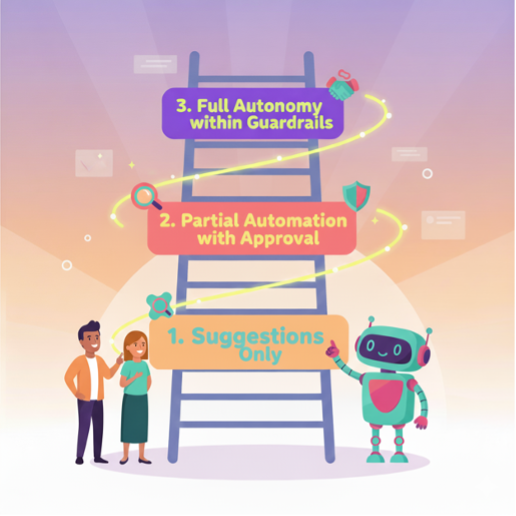 Figure 1. A progressive approach to agent autonomy. Source: Author, generated with Google Gemini.
Three Things Product Managers Should Focus On
Knowledge
Understand enough about how agents use tools, memory, context, and orchestration to recognize both opportunities and limitations. Product managers do not need to become AI engineers, but they do need enough technical fluency to make informed product decisions.
Alignment
Establish a shared understanding of the agent's goal, scope, constraints, and decision boundaries. The more autonomy a system has, the more important this alignment becomes.
Measurement
Measure more than success. Understand where the agent fails, how it recovers, how often humans intervene, and whether users trust the system. These measures help teams determine whether greater autonomy is actually creating value.
Final Thoughts
The future of AI products will not be defined by how many agents organizations build. It will be defined by whether those agents solve meaningful problems better than the alternatives. For product managers, the challenge is to avoid both extremes: dismissing agentic AI because it introduces uncertainty, while also resisting the temptation to turn every AI capability into an autonomous agent. Sometimes the right product decision will be to build an agent.
Sometimes the right decision will be to build something much simpler. Good product management for agentic AI starts with knowing the difference.
Where are you seeing the strongest case for agentic AI in your organization or industry, and where have you found that a simpler AI solution delivers more value? Share your experience in the comments.
About the Author
Shruti Tiwari is an enterprise AI Product Manager focused on building AI products and translating emerging technologies into practical customer and business outcomes. Her work spans generative AI, agentic systems, and AI product strategy.